RCD-016 Polyphenols & natural pigments
Urolithin A
A gut-microbial metabolite of dietary ellagitannins that induces mitophagy. It extended worm lifespan and has small placebo-controlled trials in older adults.
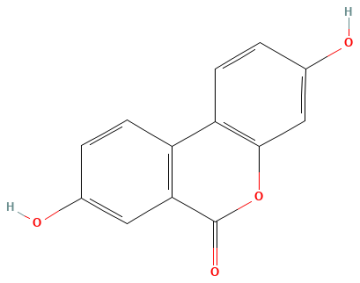
Compound data
Identifiers
- IUPAC name
- 3,8-dihydroxybenzo[c]chromen-6-one
- Synonyms
- 3,8-dihydroxy-6H-benzo[c]chromen-6-one, UA, Mitopure
- InChIKey
- RIUPLDUFZCXCHM-UHFFFAOYSA-N
- SMILES
- C1=CC2=C(C=C1O)C(=O)OC3=C2C=CC(=C3)O
Properties
- Formula
- C13H8O4
- Molecular weight
- 228.20 g/mol
- Monoisotopic mass
- 228.04225873 Da
- XLogP3
- 2.3
- Polar surface area
- 66.8 Ų
- H-bond donors / acceptors
- 2 / 4
- Rotatable bonds
- 0
- Heavy atoms
- 17
- Formal charge
- 0
Computed by PubChem from the structure. About these values
Classification
- Mechanisms studied
- Origin
- Made by gut bacteria from ellagitannins in pomegranates, walnuts and berries
- Status
- Food or supplement
- Last reviewed
This record summarises chemistry and published research. It gives no doses, protocols or sources, and it is not a recommendation to use this compound.
Overview
Urolithin A is a dibenzopyranone that the human body does not make from scratch: it is produced by gut bacteria from ellagic acid released from ellagitannins. Only some people carry the bacteria needed, so the same diet produces very different urolithin A levels from person to person.
Mechanism
In cells and animals, urolithin A induces mitophagy, the selective autophagic removal of damaged mitochondria. Ryu and colleagues showed that it extended the lifespan of C. elegans in a mitophagy-dependent way and improved muscle function in rodents (Ryu et al., 2016). The upstream target that triggers mitophagy is not established.
Research history
Urolithins were identified in the 2000s as the main circulating metabolites of pomegranate and berry ellagitannins. A Swiss company developed purified urolithin A as an ingredient after the 2016 report.
Preclinical literature
Beyond the worm lifespan data, rodent studies report improved endurance and muscle function in aged animals and in models of muscular dystrophy (Ryu et al., 2016). No lifespan study in mice has been published.
Human research & status
A first-in-human study found urolithin A safe over four weeks and reported changes in mitochondrial and autophagy gene expression in muscle (Andreux et al., 2019). In a four-month trial in older adults, it improved hand and leg muscle endurance but did not improve six-minute walk distance, the primary end point (Liu et al., 2022). These trials were funded by the manufacturer.
References
- Ryu D, Mouchiroud L, Andreux PA, et al. Urolithin A induces mitophagy and prolongs lifespan in C. elegans and increases muscle function in rodents. Nat Med. 2016;22(8):879-88. DOI PubMed
- Andreux PA, Blanco-Bose W, Ryu D, et al. The mitophagy activator urolithin A is safe and induces a molecular signature of improved mitochondrial and cellular health in humans. Nat Metab. 2019;1(6):595-603. DOI PubMed
- Liu S, D'Amico D, Shankland E, et al. Effect of Urolithin A Supplementation on Muscle Endurance and Mitochondrial Health in Older Adults: A Randomized Clinical Trial. JAMA Netw Open. 2022;5(1):e2144279. DOI PubMed