RCD-020 Nucleotides & NAD+ precursors
Nicotinamide mononucleotide
The nucleotide one step before NAD+ in the salvage pathway. Long-term NMN countered age-related decline in mice, and a small trial found improved muscle insulin sensitivity in women with prediabetes.
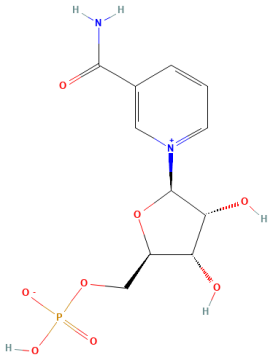
Compound data
Identifiers
- IUPAC name
- [(2R,3S,4R,5R)-5-(3-carbamoylpyridin-1-ium-1-yl)-3,4-dihydroxyoxolan-2-yl]methyl hydrogen phosphate
- Synonyms
- NMN, β-NMN, β-nicotinamide mononucleotide
- InChIKey
- DAYLJWODMCOQEW-TURQNECASA-N
- SMILES
- C1=CC(=C[N+](=C1)[C@H]2[C@@H]([C@@H]([C@H](O2)COP(=O)(O)[O-])O)O)C(=O)N
Properties
- Formula
- C11H15N2O8P
- Molecular weight
- 334.22 g/mol
- Monoisotopic mass
- 334.05660244 Da
- XLogP3
- -3.5
- Polar surface area
- 166 Ų
- H-bond donors / acceptors
- 4 / 8
- Rotatable bonds
- 5
- Heavy atoms
- 22
- Formal charge
- 0
Computed by PubChem from the structure. About these values
Classification
- Mechanisms studied
- Origin
- Natural NAD+ intermediate; made from nicotinamide by the enzyme NAMPT
- Status
- Food or supplement
- Last reviewed
This record summarises chemistry and published research. It gives no doses, protocols or sources, and it is not a recommendation to use this compound.
Overview
NMN is nicotinamide joined to ribose 5′-phosphate. In the NAD+ salvage pathway, NAMPT converts nicotinamide to NMN, and NMNAT enzymes add an adenylyl group to make NAD+. Because NAMPT is the rate-limiting step, supplying NMN bypasses it.
Mechanism
NAD+ is a cofactor in hundreds of redox reactions and the substrate consumed by sirtuins, PARPs and the NADase CD38. Tissue NAD+ falls with age in rodents, partly because CD38 activity rises, and restoring NAD+ improves mitochondrial and metabolic function in many models (Rajman et al., 2018). How NMN enters cells is debated: it may be converted to nicotinamide riboside outside the cell, and a dedicated transporter, Slc12a8, has been proposed.
Research history
NMN was characterised as an NAD+ intermediate in the mid-twentieth century. Its use as an NAD+ booster in aging research followed work in the 2000s and 2010s showing that NAD+ decline contributes to metabolic dysfunction in aged and obese mice (Verdin, 2015).
Preclinical literature
In a twelve-month study, NMN in drinking water mitigated age-associated weight gain, improved energy metabolism, insulin sensitivity and eye function, and was well tolerated in normal mice (Mills et al., 2016). No multi-site mouse lifespan study of NMN has been published.
Human research & status
In a ten-week placebo-controlled trial in 25 postmenopausal women with prediabetes, NMN increased muscle insulin sensitivity and insulin signalling without changing body composition or blood pressure (Yoshino et al., 2021). Other small trials report that NMN is well tolerated and raises blood NAD+ metabolites, with inconsistent effects on function.
References
- Rajman L, Chwalek K, Sinclair DA. Therapeutic Potential of NAD-Boosting Molecules: The In Vivo Evidence. Cell Metab. 2018;27(3):529-547. DOI PubMed
- Verdin E. NAD⁺ in aging, metabolism, and neurodegeneration. Science. 2015;350(6265):1208-13. DOI PubMed
- Mills KF, Yoshida S, Stein LR, et al. Long-Term Administration of Nicotinamide Mononucleotide Mitigates Age-Associated Physiological Decline in Mice. Cell Metab. 2016;24(6):795-806. DOI PubMed
- Yoshino M, Yoshino J, Kayser BD, et al. Nicotinamide mononucleotide increases muscle insulin sensitivity in prediabetic women. Science. 2021;372(6547):1224-1229. DOI PubMed