RCD-026 Carbohydrates & sugar analogues
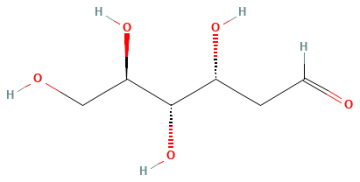
2-Deoxy-D-glucose
A glucose analogue that cells take up but cannot fully metabolise, so it blocks glycolysis. Proposed as a calorie-restriction mimetic, it extended worm lifespan but damaged the heart in rats.
Compound data
Identifiers
- IUPAC name
- (3R,4S,5R)-3,4,5,6-tetrahydroxyhexanal
- Synonyms
- 2-DG, 2-Deoxyglucose, 2-Deoxy-D-arabino-hexose
- InChIKey
- VRYALKFFQXWPIH-PBXRRBTRSA-N
- SMILES
- C(C=O)[C@H]([C@@H]([C@@H](CO)O)O)O
Properties
- Formula
- C6H12O5
- Molecular weight
- 164.16 g/mol
- Monoisotopic mass
- 164.06847348 Da
- XLogP3
- -2.9
- Polar surface area
- 98 Ų
- H-bond donors / acceptors
- 4 / 5
- Rotatable bonds
- 5
- Heavy atoms
- 11
- Formal charge
- 0
Computed by PubChem from the structure. About these values
Classification
- Mechanisms studied
- Origin
- Synthetic glucose analogue lacking the 2-hydroxyl group
- Status
- Investigational drug
- Last reviewed
This record summarises chemistry and published research. It gives no doses, protocols or sources, and it is not a recommendation to use this compound.
Overview
2-Deoxy-D-glucose is glucose with the hydroxyl group at carbon 2 replaced by hydrogen. Glucose transporters carry it into cells, and hexokinase phosphorylates it to 2-DG-6-phosphate, which cannot continue through glycolysis and accumulates. Its radioactive cousin, 18F-fluorodeoxyglucose, is the tracer used in PET scans.
Mechanism
Accumulated 2-DG-6-phosphate inhibits hexokinase and phosphoglucose isomerase, reducing glycolytic flux and ATP production from glucose. 2-DG also interferes with N-linked glycosylation because it resembles mannose. In C. elegans, impairing glycolysis with 2-DG increased mitochondrial respiration and a transient rise in reactive oxygen species, which in turn induced protective responses, a process called mitohormesis (Schulz et al., 2007).
Research history
2-DG has been studied as an anti-cancer agent since the 1950s because many tumours rely heavily on glycolysis. In the 2000s it was proposed as a calorie-restriction mimetic because it reduces glucose use without reducing food intake.
Preclinical literature
2-DG extended the lifespan of C. elegans (Schulz et al., 2007). In rats, chronic dietary 2-DG caused vacuolisation of heart muscle cells and increased mortality, which ended interest in it as a long-term calorie-restriction mimetic (Minor et al., 2010).
Human research & status
In a phase 1 trial in advanced solid tumours, 2-DG alone or combined with docetaxel was tolerated with side effects resembling hypoglycaemia and QT prolongation at higher exposures (Raez et al., 2013). It remains investigational.
References
- Schulz TJ, Zarse K, Voigt A, et al. Glucose restriction extends Caenorhabditis elegans life span by inducing mitochondrial respiration and increasing oxidative stress. Cell Metab. 2007;6(4):280-93. DOI PubMed
- Minor RK, Smith DL Jr, Sossong AM, et al. Chronic ingestion of 2-deoxy-D-glucose induces cardiac vacuolization and increases mortality in rats. Toxicol Appl Pharmacol. 2010;243(3):332-9. DOI PubMed
- Raez LE, Papadopoulos K, Ricart AD, et al. A phase I dose-escalation trial of 2-deoxy-D-glucose alone or combined with docetaxel in patients with advanced solid tumors. Cancer Chemother Pharmacol. 2013;71(2):523-30. DOI PubMed