RCD-031 Quinones & redox cofactors
Pyrroloquinoline quinone
A tricyclic ortho-quinone cofactor of bacterial dehydrogenases. A 2003 claim that it is a vitamin for mammals was disputed, and it stimulates mitochondrial biogenesis in cultured cells.
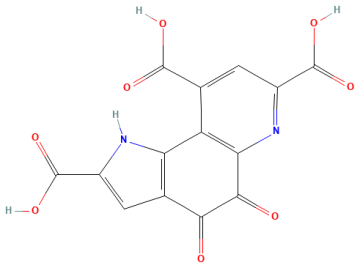
Compound data
Identifiers
- IUPAC name
- 4,5-dioxo-1H-pyrrolo[2,3-f]quinoline-2,7,9-tricarboxylic acid
- Synonyms
- PQQ, Methoxatin, BioPQQ (disodium salt)
- InChIKey
- MMXZSJMASHPLLR-UHFFFAOYSA-N
- SMILES
- C1=C(C2=C(C(=O)C(=O)C3=C2NC(=C3)C(=O)O)N=C1C(=O)O)C(=O)O
Properties
- Formula
- C14H6N2O8
- Molecular weight
- 330.21 g/mol
- Monoisotopic mass
- 330.01241515 Da
- XLogP3
- -0.1
- Polar surface area
- 175 Ų
- H-bond donors / acceptors
- 4 / 9
- Rotatable bonds
- 3
- Heavy atoms
- 24
- Formal charge
- 0
Computed by PubChem from the structure. About these values
Classification
- Mechanisms studied
- Origin
- Bacterial redox cofactor; found in trace amounts in foods and human milk
- First described
- 1979
- Status
- Food or supplement
- Last reviewed
This record summarises chemistry and published research. It gives no doses, protocols or sources, and it is not a recommendation to use this compound.
Overview
PQQ is a fused pyrrole–quinoline ring system carrying three carboxylic acids and an ortho-quinone. It is an efficient redox cycler, able to undergo thousands of oxidation–reduction cycles in vitro.
Mechanism
In bacteria, PQQ is the cofactor of methanol and glucose dehydrogenases (Salisbury et al., 1979). In mammalian cells, it increased mitochondrial number and respiration through phosphorylation of the transcription factor CREB and induction of the biogenesis regulator PGC-1α (Chowanadisai et al., 2010). No mammalian enzyme that uses PQQ as a cofactor has been established.
Research history
Salisbury and colleagues identified PQQ in 1979 as a new coenzyme in bacterial alcohol dehydrogenases. In 2003, Kasahara and Kato proposed that it is a vitamin for mammals because a mouse enzyme appeared to require it (Kasahara and Kato, 2003), but that conclusion was challenged on biochemical grounds (Felton and Anthony, 2005).
Preclinical literature
Rodents fed PQQ-deficient diets show poor growth and reproduction and fewer mitochondria. Supplementation studies report protection in models of cardiac and neural injury.
Human research & status
Small human studies report changes in inflammatory markers and some measures of cognition, without independent replication. There are no aging outcome trials.
References
- Salisbury SA, Forrest HS, Cruse WB, et al. A novel coenzyme from bacterial primary alcohol dehydrogenases. Nature. 1979;280(5725):843-4. DOI PubMed
- Kasahara T, Kato T. Nutritional biochemistry: A new redox-cofactor vitamin for mammals. Nature. 2003;422(6934):832. DOI PubMed
- Felton LM, Anthony C. Biochemistry: role of PQQ as a mammalian enzyme cofactor?. Nature. 2005;433(7025):E10; discussion E11-2. DOI PubMed
- Chowanadisai W, Bauerly KA, Tchaparian E, et al. Pyrroloquinoline quinone stimulates mitochondrial biogenesis through cAMP response element-binding protein phosphorylation and increased PGC-1alpha expression. J Biol Chem. 2010;285(1):142-52. DOI PubMed