RCD-027 Carbohydrates & sugar analogues
Trehalose
A non-reducing glucose disaccharide that helps organisms survive drying. In cells and mouse disease models it induces autophagy independently of mTOR.
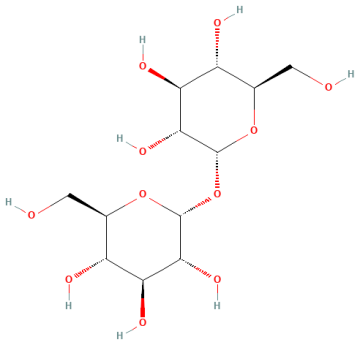
Compound data
Identifiers
- IUPAC name
- (2R,3S,4S,5R,6R)-2-(hydroxymethyl)-6-[(2R,3R,4S,5S,6R)-3,4,5-trihydroxy-6-(hydroxymethyl)oxan-2-yl]oxyoxane-3,4,5-triol
- Synonyms
- α,α-Trehalose, Mycose, Tremalose
- InChIKey
- HDTRYLNUVZCQOY-LIZSDCNHSA-N
- SMILES
- C([C@@H]1[C@H]([C@@H]([C@H]([C@H](O1)O[C@@H]2[C@@H]([C@H]([C@@H]([C@H](O2)CO)O)O)O)O)O)O)O
Properties
- Formula
- C12H22O11
- Molecular weight
- 342.30 g/mol
- Monoisotopic mass
- 342.11621151 Da
- XLogP3
- -4.2
- Polar surface area
- 190 Ų
- H-bond donors / acceptors
- 8 / 11
- Rotatable bonds
- 4
- Heavy atoms
- 23
- Formal charge
- 0
Computed by PubChem from the structure. About these values
Classification
- Mechanisms studied
- Origin
- Disaccharide in fungi, insects, yeast and desiccation-tolerant plants; produced enzymatically from starch
- Status
- Food or supplement
- Last reviewed
This record summarises chemistry and published research. It gives no doses, protocols or sources, and it is not a recommendation to use this compound.
Overview
Trehalose consists of two glucose units joined through their anomeric carbons by an α,α-1,1 bond. That linkage makes it non-reducing and very stable, and it lets organisms such as tardigrades and resurrection plants survive almost complete drying by stabilising proteins and membranes.
Mechanism
Sarkar and colleagues showed that trehalose induced autophagy in mammalian cells through a pathway independent of mTOR and enhanced the clearance of aggregation-prone proteins linked to Huntington’s and Parkinson’s disease (Sarkar et al., 2007). Later work suggested that it acts by inhibiting glucose transporters and through the lysosomal transcription factor TFEB. Humans have trehalase in the intestine, so much oral trehalose is split into glucose.
Research history
Trehalose was described in the nineteenth century from ergot of rye and from trehala manna, the cocoons of a beetle. An enzymatic process from starch developed in the 1990s made it cheap, and it became a widespread food ingredient.
Preclinical literature
Trehalose extended the lifespan of C. elegans and increased tolerance to stress (Honda et al., 2010). In mouse models of neurodegenerative disease, it reduced protein aggregates and slowed some signs of disease. No mouse lifespan study has been published.
Human research & status
There are no aging trials. Intravenous trehalose has been tested in small studies of rare neurodegenerative diseases.
References
- Sarkar S, Davies JE, Huang Z, et al. Trehalose, a novel mTOR-independent autophagy enhancer, accelerates the clearance of mutant huntingtin and alpha-synuclein. J Biol Chem. 2007;282(8):5641-52. DOI PubMed
- Honda Y, Tanaka M, Honda S. Trehalose extends longevity in the nematode Caenorhabditis elegans. Aging Cell. 2010;9(4):558-69. DOI PubMed