RCD-034 Amino acids, amines & metabolites
Spermidine
A natural polyamine that induces autophagy. It extended lifespan in yeast, worms and flies, and in mice, but a year-long trial in older adults found no memory benefit.
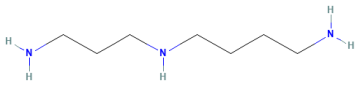
Compound data
Identifiers
- IUPAC name
- N'-(3-aminopropyl)butane-1,4-diamine
- Synonyms
- N-(3-aminopropyl)butane-1,4-diamine, Aminopropyltetramethylenediamine
- InChIKey
- ATHGHQPFGPMSJY-UHFFFAOYSA-N
- SMILES
- C(CCNCCCN)CN
Properties
- Formula
- C7H19N3
- Molecular weight
- 145.25 g/mol
- Monoisotopic mass
- 145.157897619 Da
- XLogP3
- -1
- Polar surface area
- 64.1 Ų
- H-bond donors / acceptors
- 3 / 3
- Rotatable bonds
- 7
- Heavy atoms
- 10
- Formal charge
- 0
Computed by PubChem from the structure. About these values
Classification
- Mechanisms studied
- Origin
- Polyamine made in every cell; rich in wheat germ, soybeans, mushrooms and aged cheese
- Status
- Food or supplement
- Last reviewed
This record summarises chemistry and published research. It gives no doses, protocols or sources, and it is not a recommendation to use this compound.
Overview
Spermidine is a linear triamine made from putrescine by adding an aminopropyl group. Polyamines bind nucleic acids and membranes, and they are needed for cell growth and for a unique modification of the translation factor eIF5A (hypusination). Spermidine levels in tissues fall with age in several species.
Mechanism
Spermidine induces autophagy by inhibiting acetyltransferases, especially EP300, which reduces acetylation of autophagy proteins and histones. Eisenberg and colleagues showed that its lifespan effect in yeast, worms and flies required autophagy genes (Eisenberg et al., 2009). Its eIF5A role links it to autophagy through the translation of the transcription factor TFEB.
Research history
Spermine crystals were seen in semen by Antonie van Leeuwenhoek in 1678; spermidine was characterised in the twentieth century. Its interest for aging dates from the 2009 report of lifespan extension across species.
Preclinical literature
Beyond invertebrates, spermidine in drinking water extended lifespan in mice and protected the aging heart, improving diastolic function and reducing cardiac hypertrophy in an autophagy-dependent way (Eisenberg et al., 2016).
Human research & status
In the Bruneck study, people with higher dietary spermidine intake had lower all-cause mortality over two decades, an association that persisted after adjustment for diet quality but cannot show cause (Kiechl et al., 2018). In the SmartAge trial in older adults with subjective cognitive decline, twelve months of spermidine-rich supplementation did not improve memory or other cognitive outcomes compared with placebo (Schwarz et al., 2022).
References
- Eisenberg T, Knauer H, Schauer A, et al. Induction of autophagy by spermidine promotes longevity. Nat Cell Biol. 2009;11(11):1305-14. DOI PubMed
- Eisenberg T, Abdellatif M, Schroeder S, et al. Cardioprotection and lifespan extension by the natural polyamine spermidine. Nat Med. 2016;22(12):1428-1438. DOI PubMed
- Kiechl S, Pechlaner R, Willeit P, et al. Higher spermidine intake is linked to lower mortality: a prospective population-based study. Am J Clin Nutr. 2018;108(2):371-380. DOI PubMed
- Schwarz C, Benson GS, Horn N, et al. Effects of Spermidine Supplementation on Cognition and Biomarkers in Older Adults With Subjective Cognitive Decline: A Randomized Clinical Trial. JAMA Netw Open. 2022;5(5):e2213875. DOI PubMed