RCD-042 Peptides
GHK-Cu
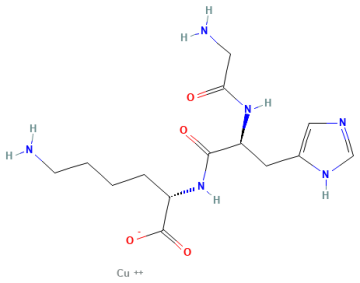
The copper complex of the tripeptide Gly-His-Lys. Plasma levels fall with age, and it stimulates collagen synthesis in skin cells. It is widely used in cosmetics.
Compound data
Identifiers
- IUPAC name
- copper (2S)-6-amino-2-[[(2S)-2-[(2-aminoacetyl)amino]-3-(1H-imidazol-5-yl)propanoyl]amino]hexanoate
- Synonyms
- Copper tripeptide-1, Glycyl-L-histidyl-L-lysine copper(II), Prezatide copper
- InChIKey
- NZWIFMYRRCMYMN-ACMTZBLWSA-M
- SMILES
- C1=C(NC=N1)C[C@@H](C(=O)N[C@@H](CCCCN)C(=O)[O-])NC(=O)CN.[Cu+2]
- Sequence
- GHK
Properties
- Formula
- C14H23CuN6O4+
- Molecular weight
- 402.92 g/mol
- Monoisotopic mass
- 402.107675 Da
- Polar surface area
- 179 Ų
- H-bond donors / acceptors
- 5 / 7
- Rotatable bonds
- 10
- Heavy atoms
- 25
- Formal charge
- 1
Computed by PubChem from the structure. About these values
Classification
- Class
- Peptides
- Mechanisms studied
- Origin
- Copper complex of a tripeptide found in human plasma, saliva and urine
- First described
- 1973
- Status
- Research compound
- Last reviewed
This record summarises chemistry and published research. It gives no doses, protocols or sources, and it is not a recommendation to use this compound.
Overview
GHK is the tripeptide glycyl-histidyl-lysine. It binds copper(II) tightly through the glycine amino group, the histidine imidazole and a backbone nitrogen, and in the body it circulates mostly as this copper complex. PubChem lists the complex as a cation; commercial material is a salt.
Mechanism
GHK-Cu stimulated synthesis of collagen and glycosaminoglycans in fibroblast cultures (Maquart et al., 1988), and it can deliver copper to enzymes such as lysyl oxidase that crosslink collagen. Analyses of gene-expression databases suggest it shifts the expression of many genes towards patterns associated with tissue repair, though these are associations rather than demonstrated mechanisms (Pickart and Margolina, 2018).
Research history
Loren Pickart identified GHK in 1973 as a factor in human plasma albumin that made old liver tissue synthesise proteins like young tissue (Pickart et al., 1973). Plasma GHK levels decline with age.
Preclinical literature
Animal studies report faster wound healing, increased angiogenesis and improved skin structure, and anti-inflammatory and antioxidant effects in models of lung and other injury (Pickart and Margolina, 2018).
Human research & status
Small, mostly industry-funded cosmetic studies report improvements in skin appearance with topical products. There are no controlled trials of systemic GHK-Cu, and it is not approved as a medicine.
References
- Pickart L, Thayer L, Thaler MM. A synthetic tripeptide which increases survival of normal liver cells, and stimulates growth in hepatoma cells. Biochem Biophys Res Commun. 1973;54(2):562-6. DOI PubMed
- Maquart FX, Pickart L, Laurent M, et al. Stimulation of collagen synthesis in fibroblast cultures by the tripeptide-copper complex glycyl-L-histidyl-L-lysine-Cu2+. FEBS Lett. 1988;238(2):343-6. DOI PubMed
- Pickart L, Margolina A. Regenerative and Protective Actions of the GHK-Cu Peptide in the Light of the New Gene Data. Int J Mol Sci. 2018;19(7). DOI PubMed