RCD-014 Polyphenols & natural pigments
Curcumin
The yellow pigment of turmeric. Medicinal chemists describe it as unstable, reactive and poorly bioavailable, and it did not extend lifespan in the ITP.
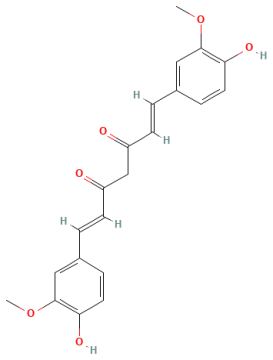
Compound data
Identifiers
- IUPAC name
- (1E,6E)-1,7-bis(4-hydroxy-3-methoxyphenyl)hepta-1,6-diene-3,5-dione
- Synonyms
- Diferuloylmethane, Turmeric yellow, C.I. 75300, E100
- InChIKey
- VFLDPWHFBUODDF-FCXRPNKRSA-N
- SMILES
- COC1=C(C=CC(=C1)/C=C/C(=O)CC(=O)/C=C/C2=CC(=C(C=C2)O)OC)O
Properties
- Formula
- C21H20O6
- Molecular weight
- 368.4 g/mol
- Monoisotopic mass
- 368.12598835 Da
- XLogP3
- 3.2
- Polar surface area
- 93.1 Ų
- H-bond donors / acceptors
- 2 / 6
- Rotatable bonds
- 8
- Heavy atoms
- 27
- Formal charge
- 0
Computed by PubChem from the structure. About these values
Classification
- Mechanisms studied
- Origin
- Main curcuminoid of turmeric (Curcuma longa) rhizome
- First described
- 1815
- Status
- Food or supplement
- Last reviewed
This record summarises chemistry and published research. It gives no doses, protocols or sources, and it is not a recommendation to use this compound.
Overview
Curcumin is a diarylheptanoid with two feruloyl groups joined by a β-diketone that exists mostly in its enol form. It gives turmeric its colour and has been the subject of thousands of papers and more than a hundred clinical trials.
Mechanism
Curcumin affects many signalling molecules in vitro, including NF-κB, COX-2 and NRF2. A critical review by medicinal chemists argued that it is a pan-assay interference compound: it is chemically unstable at physiological pH, reactive towards proteins, fluorescent, aggregating and membrane-disrupting, and they concluded that no double-blinded, placebo-controlled trial had shown it to be effective for any indication (Nelson et al., 2017).
Research history
Curcumin was isolated from turmeric in 1815, and its structure was determined in 1910. Turmeric has a long history in South Asian cooking and traditional medicine, which helped drive the modern research interest.
Preclinical literature
Cell and rodent studies report anti-inflammatory, anti-cancer and neuroprotective effects, often at concentrations that cannot be reached in blood. Curcumin extended lifespan in some invertebrate studies but did not extend the lifespan of genetically heterogeneous mice in the ITP (Strong et al., 2013).
Human research & status
Oral curcumin is poorly absorbed and rapidly conjugated, so blood levels of free curcumin are very low (Anand et al., 2007). Formulations with piperine, phospholipids or nanoparticles raise exposure, but they also change the safety profile, and rare cases of liver injury have been linked to such products.
References
- Nelson KM, Dahlin JL, Bisson J, et al. The Essential Medicinal Chemistry of Curcumin. J Med Chem. 2017;60(5):1620-1637. DOI PubMed
- Anand P, Kunnumakkara AB, Newman RA, et al. Bioavailability of curcumin: problems and promises. Mol Pharm. 2007;4(6):807-18. DOI PubMed
- Strong R, Miller RA, Astle CM, et al. Evaluation of resveratrol, green tea extract, curcumin, oxaloacetic acid, and medium-chain triglyceride oil on life span of genetically heterogeneous mice. J Gerontol A Biol Sci Med Sci. 2013;68(1):6-16. DOI PubMed