RCD-043 Peptides
MOTS-c
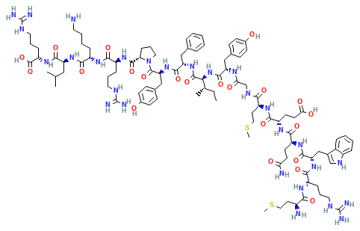
A 16-residue peptide encoded in mitochondrial DNA. It activates AMPK through the folate cycle, moves to the nucleus under stress, and is induced by exercise.
Compound data
Identifiers
- IUPAC name
- (4S)-4-[[(2S)-5-amino-2-[[(2S)-2-[[(2S)-2-[[(2S)-2-amino-4-methylsulfanylbutanoyl]amino]-5-carbamimidamidopentanoyl]amino]-3-(1H-indol-3-yl)propanoyl]amino]-5-oxopentanoyl]amino]-5-[[(2S)-1-[[2-[[(2S)-1-[[(2S,3S)-1-[[(2S)-1-[[(2S)-1-[(2S)-2-[[(2S)-1-[[(2S)-6-amino-1-[[(2S)-1-[[(1S)-4-carbamimidamido-1-carboxybutyl]amino]-4-methyl-1-oxopentan-2-yl]amino]-1-oxohexan-2-yl]amino]-5-carbamimidamido-1-oxopentan-2-yl]carbamoyl]pyrrolidin-1-yl]-3-(4-hydroxyphenyl)-1-oxopropan-2-yl]amino]-1-oxo-3-phenylpropan-2-yl]amino]-3-methyl-1-oxopentan-2-yl]amino]-3-(4-hydroxyphenyl)-1-oxopropan-2-yl]amino]-2-oxoethyl]amino]-4-methylsulfanyl-1-oxobutan-2-yl]amino]-5-oxopentanoic acid
- Synonyms
- Mitochondrial open reading frame of the 12S rRNA-c, Mitochondrial-derived peptide MOTS-c
- InChIKey
- WYTHCOXVWRKRAH-LOKRTKBUSA-N
- SMILES
- CC[C@H](C)[C@@H](C(=O)N[C@@H](CC1=CC=CC=C1)C(=O)N[C@@H](CC2=CC=C(C=C2)O)C(=O)N3CCC[C@H]3C(=O)N[C@@H](CCCNC(=N)N)C(=O)N[C@@H](CCCCN)C(=O)N[C@@H](CC(C)C)C(=O)N[C@@H](CCCNC(=N)N)C(=O)O)NC(=O)[C@H](CC4=CC=C(C=C4)O)NC(=O)CNC(=O)[C@H](CCSC)NC(=O)[C@H](CCC(=O)O)NC(=O)[C@H](CCC(=O)N)NC(=O)[C@H](CC5=CNC6=CC=CC=C65)NC(=O)[C@H](CCCNC(=N)N)NC(=O)[C@H](CCSC)N
- Sequence
- MRWQEMGYIFYPRKLR
Properties
- Formula
- C101H152N28O22S2
- Molecular weight
- 2174.6 g/mol
- Monoisotopic mass
- 2174.1110958 Da
- XLogP3
- -3.9
- Polar surface area
- 890 Ų
- H-bond donors / acceptors
- 31 / 29
- Rotatable bonds
- 73
- Heavy atoms
- 153
- Formal charge
- 0
Computed by PubChem from the structure. About these values
Classification
- Class
- Peptides
- Mechanisms studied
- Origin
- Encoded by a short open reading frame in the mitochondrial 12S rRNA gene
- First described
- 2015
- Status
- Research compound
- Last reviewed
This record summarises chemistry and published research. It gives no doses, protocols or sources, and it is not a recommendation to use this compound.
Overview
MOTS-c is one of a small group of mitochondrial-derived peptides, short proteins encoded within the mitochondrial genome rather than the nuclear genome. Its discovery showed that mitochondria can send peptide signals to the rest of the cell and body.
Mechanism
Lee and colleagues found that MOTS-c inhibited the folate cycle and de novo purine synthesis, causing accumulation of the AMP analogue AICAR (as ZMP) and activation of AMPK, mainly in skeletal muscle (Lee et al., 2015). Under metabolic stress, MOTS-c moves into the nucleus and regulates genes with antioxidant response elements through NRF2 (Kim et al., 2018).
Research history
Changhan Lee, Pinchas Cohen and colleagues at the University of Southern California identified MOTS-c in 2015, following the earlier discovery of humanin. Common mitochondrial DNA variants that change its sequence have been studied in human populations.
Preclinical literature
In mice, MOTS-c prevented diet-induced obesity and insulin resistance (Lee et al., 2015). Reynolds and colleagues found that exercise raised MOTS-c in human muscle and blood, and that treating mice late in life improved physical capacity, while treatment from middle age improved healthspan measures (Reynolds et al., 2021).
Human research & status
Human data are observational: circulating MOTS-c levels differ with age, metabolic disease and exercise. An analogue was tested in early clinical trials for metabolic disease. MOTS-c is not approved for any use.
References
- Lee C, Zeng J, Drew BG, et al. The mitochondrial-derived peptide MOTS-c promotes metabolic homeostasis and reduces obesity and insulin resistance. Cell Metab. 2015;21(3):443-54. DOI PubMed
- Kim KH, Son JM, Benayoun BA, et al. The Mitochondrial-Encoded Peptide MOTS-c Translocates to the Nucleus to Regulate Nuclear Gene Expression in Response to Metabolic Stress. Cell Metab. 2018;28(3):516-524.e7. DOI PubMed
- Reynolds JC, Lai RW, Woodhead JST, et al. MOTS-c is an exercise-induced mitochondrial-encoded regulator of age-dependent physical decline and muscle homeostasis. Nat Commun. 2021;12(1):470. DOI PubMed