RCD-033 Quinones & redox cofactors
Methylene blue
A phenothiazinium dye and the first synthetic drug. It shuttles electrons in mitochondria and delayed senescence in cultured cells, and it is a potent MAO-A inhibitor.
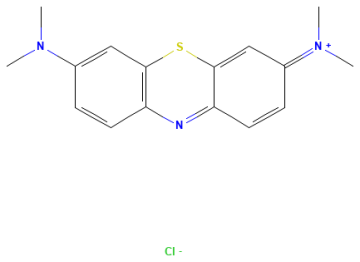
Compound data
Identifiers
- IUPAC name
- [7-(dimethylamino)phenothiazin-3-ylidene]-dimethylazanium chloride
- Synonyms
- Methylthioninium chloride, Basic Blue 9, C.I. 52015, ProvayBlue
- InChIKey
- CXKWCBBOMKCUKX-UHFFFAOYSA-M
- SMILES
- CN(C)C1=CC2=C(C=C1)N=C3C=CC(=[N+](C)C)C=C3S2.[Cl-]
Properties
- Formula
- C16H18ClN3S
- Molecular weight
- 319.9 g/mol
- Monoisotopic mass
- 319.0909965 Da
- Polar surface area
- 43.9 Ų
- H-bond donors / acceptors
- 0 / 4
- Rotatable bonds
- 1
- Heavy atoms
- 21
- Formal charge
- 0
Computed by PubChem from the structure. About these values
Classification
- Mechanisms studied
- Origin
- Synthetic phenothiazinium dye, first made in 1876
- First described
- 1876
- Status
- Approved medicine
- Last reviewed
This record summarises chemistry and published research. It gives no doses, protocols or sources, and it is not a recommendation to use this compound.
Overview
Methylene blue is a cationic phenothiazinium dye that is deep blue when oxidised and colourless as leucomethylene blue when reduced. It is used as a stain, as an antidote, as a surgical marker and in research on mitochondrial function (Wainwright and Crossley, 2002).
Mechanism
Methylene blue accepts electrons from NADH and passes them to cytochrome c, bypassing complexes I and III. In cultured human fibroblasts this increased complex IV activity and oxygen consumption and delayed the onset of replicative senescence (Atamna et al., 2008). In methaemoglobinaemia it acts as a cofactor that reduces methaemoglobin back to haemoglobin. It is also a potent reversible inhibitor of monoamine oxidase A.
Research history
Heinrich Caro synthesised methylene blue at BASF in 1876. Paul Ehrlich used it to treat malaria in 1891, making it the first synthetic drug used in medicine, and it led indirectly to phenothiazine antipsychotics (Wainwright and Crossley, 2002).
Preclinical literature
Cell and rodent studies report neuroprotective effects in models of Alzheimer’s and Parkinson’s disease and stroke, often with a bell-shaped dose response in which higher exposures are less effective or harmful.
Human research & status
Methylene blue is an approved intravenous antidote for acquired methaemoglobinaemia. A derivative was tested in Alzheimer’s disease phase 3 trials without clear benefit. Because it inhibits MAO-A, it can cause serotonin toxicity when combined with serotonergic antidepressants (Gillman, 2011), and it causes haemolysis in people with G6PD deficiency.
References
- Wainwright M, Crossley KB. Methylene Blue--a therapeutic dye for all seasons?. J Chemother. 2002;14(5):431-43. DOI PubMed
- Atamna H, Nguyen A, Schultz C, et al. Methylene blue delays cellular senescence and enhances key mitochondrial biochemical pathways. FASEB J. 2008;22(3):703-12. DOI PubMed
- Gillman PK. CNS toxicity involving methylene blue: the exemplar for understanding and predicting drug interactions that precipitate serotonin toxicity. J Psychopharmacol. 2011;25(3):429-36. DOI PubMed