RCD-025 Carbohydrates & sugar analogues
Acarbose
An α-glucosidase inhibitor that slows starch digestion and blunts post-meal glucose spikes. In the ITP it extended lifespan substantially in male mice and slightly in females.
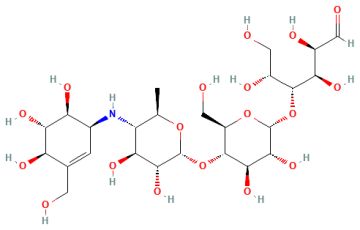
Compound data
Identifiers
- IUPAC name
- (2R,3R,4R,5R)-4-[(2R,3R,4R,5S,6R)-5-[(2R,3R,4S,5S,6R)-3,4-dihydroxy-6-methyl-5-[[(1S,4R,5S,6S)-4,5,6-trihydroxy-3-(hydroxymethyl)cyclohex-2-en-1-yl]amino]oxan-2-yl]oxy-3,4-dihydroxy-6-(hydroxymethyl)oxan-2-yl]oxy-2,3,5,6-tetrahydroxyhexanal
- Synonyms
- BAY g 5421, Precose, Glucobay
- InChIKey
- CEMXHAPUFJOOSV-XGWNLRGSSA-N
- SMILES
- C[C@@H]1[C@H]([C@@H]([C@H]([C@H](O1)O[C@@H]2[C@H](O[C@@H]([C@@H]([C@H]2O)O)O[C@H]([C@@H](CO)O)[C@@H]([C@H](C=O)O)O)CO)O)O)N[C@H]3C=C([C@H]([C@@H]([C@H]3O)O)O)CO
Properties
- Formula
- C25H43NO18
- Molecular weight
- 645.6 g/mol
- Monoisotopic mass
- 645.24801352 Da
- XLogP3
- -8.8
- Polar surface area
- 329 Ų
- H-bond donors / acceptors
- 14 / 19
- Rotatable bonds
- 13
- Heavy atoms
- 44
- Formal charge
- 0
Computed by PubChem from the structure. About these values
Classification
- Mechanisms studied
- Origin
- Pseudo-tetrasaccharide made by Actinoplanes bacteria
- Status
- Approved medicine
- Last reviewed
This record summarises chemistry and published research. It gives no doses, protocols or sources, and it is not a recommendation to use this compound.
Overview
Acarbose is a pseudo-oligosaccharide: an aminocyclitol (valienamine) linked to a deoxyglucose and two glucose units. It resembles the starch fragments that intestinal enzymes digest, binds those enzymes much more tightly than their natural substrates, and is barely absorbed.
Mechanism
Acarbose inhibits α-glucosidases in the brush border of the small intestine and pancreatic α-amylase. Starch and sucrose are digested more slowly and further along the gut, so post-meal glucose and insulin peaks are lower, and more carbohydrate reaches the colon, where bacteria ferment it to short-chain fatty acids. Both the smoother glucose profile and the change in microbial metabolism have been proposed as reasons for its effects in mice.
Research history
Bayer isolated acarbose from Actinoplanes cultures in the 1970s, and it was approved for diabetes in Germany in 1990 and in the United States in 1995. In the STOP-NIDDM trial in people with impaired glucose tolerance, acarbose reduced progression to type 2 diabetes (Chiasson et al., 2002).
Preclinical literature
In the ITP, acarbose started in young adulthood increased median lifespan in genetically heterogeneous mice, with a much larger effect in males than in females (Harrison et al., 2014). A follow-up found benefits at several doses and even when treatment began at 16 months, along with improvements in some measures of health (Harrison et al., 2019; Strong et al., 2016).
Human research & status
Human data come from diabetes and pre-diabetes trials. Flatulence and bloating from colonic fermentation are common and are the main reason people stop taking it. Acarbose is a prescription medicine and is not used for aging.
References
- Chiasson JL, Josse RG, Gomis R, et al. Acarbose for prevention of type 2 diabetes mellitus: the STOP-NIDDM randomised trial. Lancet. 2002;359(9323):2072-7. DOI PubMed
- Harrison DE, Strong R, Allison DB, et al. Acarbose, 17-α-estradiol, and nordihydroguaiaretic acid extend mouse lifespan preferentially in males. Aging Cell. 2014;13(2):273-82. DOI PubMed
- Harrison DE, Strong R, Alavez S, et al. Acarbose improves health and lifespan in aging HET3 mice. Aging Cell. 2019;18(2):e12898. DOI PubMed
- Strong R, Miller RA, Antebi A, et al. Longer lifespan in male mice treated with a weakly estrogenic agonist, an antioxidant, an α-glucosidase inhibitor or a Nrf2-inducer. Aging Cell. 2016;15(5):872-84. DOI PubMed