RCD-001 Macrolides & rapalogs
Rapamycin
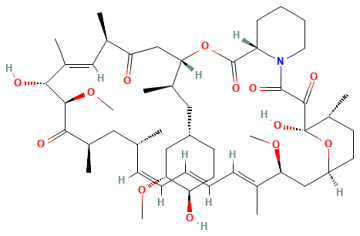
A macrolide from a soil bacterium that inhibits mTOR complex 1. It extends lifespan in genetically diverse mice of both sexes, including when started late in life, a result replicated across several cohorts.
Compound data
Identifiers
- IUPAC name
- (1R,9S,12S,15R,16E,18R,19R,21R,23S,24E,26E,28E,30S,32S,35R)-1,18-dihydroxy-12-[(2R)-1-[(1S,3R,4R)-4-hydroxy-3-methoxycyclohexyl]propan-2-yl]-19,30-dimethoxy-15,17,21,23,29,35-hexamethyl-11,36-dioxa-4-azatricyclo[30.3.1.04,9]hexatriaconta-16,24,26,28-tetraene-2,3,10,14,20-pentone
- Synonyms
- Sirolimus, AY-22989, Rapamune
- InChIKey
- QFJCIRLUMZQUOT-HPLJOQBZSA-N
- SMILES
- C[C@@H]1CC[C@H]2C[C@@H](/C(=C/C=C/C=C/[C@H](C[C@H](C(=O)[C@@H]([C@@H](/C(=C/[C@H](C(=O)C[C@H](OC(=O)[C@@H]3CCCCN3C(=O)C(=O)[C@@]1(O2)O)[C@H](C)C[C@@H]4CC[C@H]([C@@H](C4)OC)O)C)/C)O)OC)C)C)/C)OC
Properties
- Formula
- C51H79NO13
- Molecular weight
- 914.2 g/mol
- Monoisotopic mass
- 913.55514157 Da
- XLogP3
- 6
- Polar surface area
- 195 Ų
- H-bond donors / acceptors
- 3 / 13
- Rotatable bonds
- 6
- Heavy atoms
- 65
- Formal charge
- 0
Computed by PubChem from the structure. About these values
Classification
- Mechanisms studied
- Origin
- Streptomyces hygroscopicus, isolated from a soil sample collected on Rapa Nui (Easter Island)
- First described
- 1975
- Status
- Approved medicine
- Last reviewed
This record summarises chemistry and published research. It gives no doses, protocols or sources, and it is not a recommendation to use this compound.
Overview
Rapamycin is a 31-membered macrolide lactone made by the bacterium Streptomyces hygroscopicus. It was first described as an antifungal agent, then developed as an immunosuppressant, and is now one of the most closely studied compounds in the biology of aging. Its name comes from Rapa Nui, the island where the producing strain was collected.
Mechanism
Rapamycin binds the small intracellular protein FKBP12. The FKBP12–rapamycin complex then binds the FRB domain of the kinase mTOR and blocks the activity of mTOR complex 1 (mTORC1), which controls protein synthesis, cell growth and the suppression of autophagy (Saxton and Sabatini, 2017). mTORC1 inhibition is acute; with prolonged exposure rapamycin also disrupts the assembly of mTOR complex 2 in some tissues. In mice, the loss of hepatic mTORC2 explains the insulin resistance seen with chronic treatment, and this metabolic effect is separable from the lifespan effect (Lamming et al., 2012).
Research history
Vézina and colleagues at Ayerst Research Laboratories reported the isolation of rapamycin in 1975. Its immunosuppressive and antiproliferative properties led to clinical development, and the identification of its target, TOR in yeast and then mTOR in mammals, in the early 1990s opened a new field of nutrient-signalling research. Sirolimus was approved in the United States in 1999 for transplant medicine and is also used on drug-eluting coronary stents.
Preclinical literature
The landmark study came from the National Institute on Aging Interventions Testing Program (ITP), which tests compounds at three sites in genetically heterogeneous UM-HET3 mice. Rapamycin added to the diet from 600 days of age, roughly equivalent to 60 human years, extended median and maximal lifespan in both sexes (Harrison et al., 2009). Later ITP cohorts confirmed the effect when treatment began earlier and found larger gains in females than in males (Miller et al., 2011). Reduced mTORC1 signalling also extends lifespan in yeast, worms and flies, which makes this one of the most conserved longevity pathways known.
Human research & status
Most human data come from transplant and oncology use, where rapamycin is given continuously and its side effects include mouth ulcers, raised lipids, impaired glucose control and delayed wound healing. Studies of intermittent mTORC1 inhibition in older adults have used the rapalog everolimus and related compounds: a six-week course improved the antibody response to influenza vaccination (Mannick et al., 2014), and a combination of TORC1 inhibitors was associated with fewer reported infections (Mannick et al., 2018). Whether any regimen slows human aging is unknown. Rapamycin is a prescription medicine and is not approved for that purpose.
References
- Vézina C, Kudelski A, Sehgal SN. Rapamycin (AY-22,989), a new antifungal antibiotic. I. Taxonomy of the producing streptomycete and isolation of the active principle. J Antibiot (Tokyo). 1975;28(10):721-6. DOI PubMed
- Saxton RA, Sabatini DM. mTOR Signaling in Growth, Metabolism, and Disease. Cell. 2017;169(2):361-371. DOI PubMed
- Lamming DW, Ye L, Katajisto P, et al. Rapamycin-induced insulin resistance is mediated by mTORC2 loss and uncoupled from longevity. Science. 2012;335(6076):1638-43. DOI PubMed
- Harrison DE, Strong R, Sharp ZD, et al. Rapamycin fed late in life extends lifespan in genetically heterogeneous mice. Nature. 2009;460(7253):392-5. DOI PubMed
- Miller RA, Harrison DE, Astle CM, et al. Rapamycin, but not resveratrol or simvastatin, extends life span of genetically heterogeneous mice. J Gerontol A Biol Sci Med Sci. 2011;66(2):191-201. DOI PubMed
- Mannick JB, Del Giudice G, Lattanzi M, et al. mTOR inhibition improves immune function in the elderly. Sci Transl Med. 2014;6(268):268ra179. DOI PubMed
- Mannick JB, Morris M, Hockey HP, et al. TORC1 inhibition enhances immune function and reduces infections in the elderly. Sci Transl Med. 2018;10(449). DOI PubMed