RCD-011 Polyphenols & natural pigments
Resveratrol
The stilbene that launched the sirtuin-activator field in 2003. It protects mice on a high-calorie diet but did not extend lifespan in mice on a normal diet.
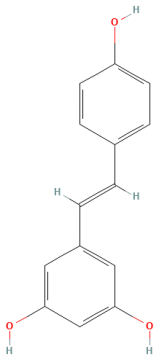
Compound data
Identifiers
- IUPAC name
- 5-[(E)-2-(4-hydroxyphenyl)ethenyl]benzene-1,3-diol
- Synonyms
- trans-Resveratrol, 3,4′,5-trihydroxy-trans-stilbene
- InChIKey
- LUKBXSAWLPMMSZ-OWOJBTEDSA-N
- SMILES
- C1=CC(=CC=C1/C=C/C2=CC(=CC(=C2)O)O)O
Properties
- Formula
- C14H12O3
- Molecular weight
- 228.24 g/mol
- Monoisotopic mass
- 228.078644241 Da
- XLogP3
- 3.1
- Polar surface area
- 60.7 Ų
- H-bond donors / acceptors
- 3 / 3
- Rotatable bonds
- 2
- Heavy atoms
- 17
- Formal charge
- 0
Computed by PubChem from the structure. About these values
Classification
- Mechanisms studied
- Origin
- Stilbene in grape skins, peanuts, berries and Japanese knotweed (Reynoutria japonica)
- First described
- 1939
- Status
- Food or supplement
- Last reviewed
This record summarises chemistry and published research. It gives no doses, protocols or sources, and it is not a recommendation to use this compound.
Overview
Resveratrol is a stilbene phytoalexin that plants make in response to injury or fungal infection. Its presence in red wine made it part of the “French paradox” discussion in the 1990s, and its reported activation of SIRT1 made it the best-known candidate longevity molecule of the 2000s.
Mechanism
Howitz and colleagues reported that resveratrol stimulated SIRT1 deacetylase activity and extended the replicative lifespan of yeast in a Sir2-dependent manner (Howitz et al., 2003). Two years later, activation was shown to depend on the fluorophore attached to the test substrate (Kaeberlein et al., 2005). Resveratrol also activates AMPK, inhibits phosphodiesterases and affects many other proteins, and its in-vivo effects likely have several sources.
Research history
Michio Takaoka isolated resveratrol in 1939 from white hellebore (Veratrum grandiflorum). It was a minor natural product until reports in the 1990s of anti-cancer activity and its occurrence in wine, followed by the 2003 sirtuin paper.
Preclinical literature
In middle-aged mice on a high-calorie diet, resveratrol improved insulin sensitivity, increased mitochondrial number and improved survival (Baur et al., 2006). In mice fed a standard diet it delayed some age-related changes but did not extend lifespan (Pearson et al., 2008). The ITP found no lifespan effect at either of two doses (Miller et al., 2011; Strong et al., 2013).
Human research & status
Many small human trials have tested resveratrol in metabolic, cardiovascular and cognitive settings, with mixed and often null results. Oral bioavailability of free resveratrol is very low because it is rapidly conjugated in the gut and liver.
References
- Howitz KT, Bitterman KJ, Cohen HY, et al. Small molecule activators of sirtuins extend Saccharomyces cerevisiae lifespan. Nature. 2003;425(6954):191-6. DOI PubMed
- Kaeberlein M, McDonagh T, Heltweg B, et al. Substrate-specific activation of sirtuins by resveratrol. J Biol Chem. 2005;280(17):17038-45. DOI PubMed
- Baur JA, Pearson KJ, Price NL, et al. Resveratrol improves health and survival of mice on a high-calorie diet. Nature. 2006;444(7117):337-42. DOI PubMed
- Pearson KJ, Baur JA, Lewis KN, et al. Resveratrol delays age-related deterioration and mimics transcriptional aspects of dietary restriction without extending life span. Cell Metab. 2008;8(2):157-68. DOI PubMed
- Miller RA, Harrison DE, Astle CM, et al. Rapamycin, but not resveratrol or simvastatin, extends life span of genetically heterogeneous mice. J Gerontol A Biol Sci Med Sci. 2011;66(2):191-201. DOI PubMed
- Strong R, Miller RA, Astle CM, et al. Evaluation of resveratrol, green tea extract, curcumin, oxaloacetic acid, and medium-chain triglyceride oil on life span of genetically heterogeneous mice. J Gerontol A Biol Sci Med Sci. 2013;68(1):6-16. DOI PubMed