RCD-003 Synthetic small molecules
Metformin
A biguanide glucose-lowering drug with more than sixty years of clinical use. Its effects on mitochondria and AMPK made it the subject of TAME, a proposed trial designed to target aging itself.
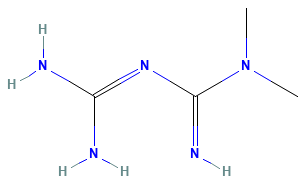
Compound data
Identifiers
- IUPAC name
- 3-(diaminomethylidene)-1,1-dimethylguanidine
- Synonyms
- Dimethylbiguanide, N,N-dimethylbiguanide, Glucophage
- InChIKey
- XZWYZXLIPXDOLR-UHFFFAOYSA-N
- SMILES
- CN(C)C(=N)N=C(N)N
Properties
- Formula
- C4H11N5
- Molecular weight
- 129.16 g/mol
- Monoisotopic mass
- 129.10144537 Da
- XLogP3
- -1.3
- Polar surface area
- 91.5 Ų
- H-bond donors / acceptors
- 3 / 1
- Rotatable bonds
- 2
- Heavy atoms
- 9
- Formal charge
- 0
Computed by PubChem from the structure. About these values
Classification
- Mechanisms studied
- Origin
- Synthetic biguanide, related to galegine from goat's rue (Galega officinalis)
- First described
- 1922
- Status
- Approved medicine
- Last reviewed
This record summarises chemistry and published research. It gives no doses, protocols or sources, and it is not a recommendation to use this compound.
Overview
Metformin is a small, highly polar biguanide. It descends from the guanidine-rich herb goat’s rue, which was used in medieval Europe for symptoms now associated with diabetes. It is cheap, off patent, and among the most prescribed medicines in the world, which is a large part of why it became a candidate for aging research.
Mechanism
Metformin accumulates in the liver and lowers glucose output mainly by reducing gluconeogenesis. The best-supported molecular action is mild inhibition of mitochondrial respiratory complex I, which lowers the cellular energy charge and activates AMP-activated protein kinase (AMPK). Several effects are AMPK-independent, including changes in the cellular redox state and in glucagon signalling, and the gut is an additional site of action (Foretz et al., 2014).
Research history
Metformin was first synthesised in 1922. Jean Sterne introduced it for diabetes in France in 1957; it reached the United Kingdom soon after and the United States in 1995 (Bailey, 2017). Interest from aging research grew when large diabetes trials and registries suggested lower rates of cancer and cardiovascular disease in metformin users than expected.
Preclinical literature
Metformin extends lifespan in C. elegans, partly by altering bacterial folate metabolism. In male C57BL/6 mice, a low dietary concentration modestly increased mean lifespan and improved physical performance and insulin sensitivity, while a ten-fold higher concentration was toxic (Martin-Montalvo et al., 2013). In the multi-site Interventions Testing Program, metformin given alone did not significantly extend lifespan in genetically heterogeneous mice (Strong et al., 2016).
Human research & status
Observational studies of people with diabetes report associations between metformin and lower mortality or cancer incidence, but these comparisons are prone to confounding and time-related biases. To test the idea directly, Barzilai and colleagues designed TAME (Targeting Aging with Metformin), a trial that would measure the combined onset of age-related diseases rather than a single condition (Barzilai et al., 2016). Metformin is a prescription medicine for type 2 diabetes; its gastrointestinal side effects, vitamin B12 lowering and rare lactic acidosis are well characterised.
References
- Bailey CJ. Metformin: historical overview. Diabetologia. 2017;60(9):1566-1576. DOI PubMed
- Foretz M, Guigas B, Bertrand L, et al. Metformin: from mechanisms of action to therapies. Cell Metab. 2014;20(6):953-66. DOI PubMed
- Martin-Montalvo A, Mercken EM, Mitchell SJ, et al. Metformin improves healthspan and lifespan in mice. Nat Commun. 2013;4:2192. DOI PubMed
- Strong R, Miller RA, Antebi A, et al. Longer lifespan in male mice treated with a weakly estrogenic agonist, an antioxidant, an α-glucosidase inhibitor or a Nrf2-inducer. Aging Cell. 2016;15(5):872-84. DOI PubMed
- Barzilai N, Crandall JP, Kritchevsky SB, et al. Metformin as a Tool to Target Aging. Cell Metab. 2016;23(6):1060-1065. DOI PubMed