RCD-032 Quinones & redox cofactors
Alpha-lipoic acid
An eight-carbon dithiolane fatty acid that serves as a covalent cofactor of mitochondrial dehydrogenases. As a supplement it was studied for diabetic neuropathy.
Compound data
Identifiers
- IUPAC name
- 5-(dithiolan-3-yl)pentanoic acid
- Synonyms
- Lipoic acid, Thioctic acid, (±)-α-Lipoic acid, R-lipoic acid (natural enantiomer)
- InChIKey
- AGBQKNBQESQNJD-UHFFFAOYSA-N
- SMILES
- C1CSSC1CCCCC(=O)O
Properties
- Formula
- C8H14O2S2
- Molecular weight
- 206.3 g/mol
- Monoisotopic mass
- 206.04352203 Da
- XLogP3
- 1.7
- Polar surface area
- 87.9 Ų
- H-bond donors / acceptors
- 1 / 4
- Rotatable bonds
- 5
- Heavy atoms
- 12
- Formal charge
- 0
Computed by PubChem from the structure. About these values
Classification
- Mechanisms studied
- Origin
- Made in mitochondria from octanoic acid; supplements are racemic or the R-enantiomer
- First described
- 1951
- Status
- Food or supplement
- Last reviewed
This record summarises chemistry and published research. It gives no doses, protocols or sources, and it is not a recommendation to use this compound.
Overview
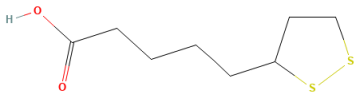
Lipoic acid is octanoic acid with a five-membered ring containing a disulfide bond. The body makes the R-enantiomer and attaches it to lysine residues of enzyme complexes; supplements are often a racemic mixture. PubChem record 864 used here describes the racemic structure without stereochemistry.
Mechanism
Protein-bound lipoate is the “swinging arm” cofactor of pyruvate dehydrogenase, α-ketoglutarate dehydrogenase and the branched-chain keto-acid dehydrogenase, which link glycolysis and amino-acid breakdown to the Krebs cycle. Free lipoic acid and its reduced form, dihydrolipoic acid, are a redox couple that can regenerate other antioxidants and chelate metals, and it activates NRF2 (Shay et al., 2009).
Research history
Lester Reed and colleagues crystallised lipoic acid in 1951 from liver and identified it as a catalytic factor of pyruvate oxidation (Reed et al., 1951). It has been prescribed in Germany for diabetic neuropathy for decades.
Preclinical literature
In aged rats, lipoic acid improved some markers of mitochondrial function and oxidative stress (Shay et al., 2009). Mouse lifespan studies have generally been negative.
Human research & status
In the SYDNEY 2 trial, five weeks of oral lipoic acid improved neuropathic symptoms in people with diabetic polyneuropathy (Ziegler et al., 2006). There are no aging outcome trials. Lipoic acid can lower blood glucose, and a rare autoimmune hypoglycaemia linked to it has been reported in people with certain HLA types.
References
- REED LJ, DeBUSK BG, GUNSALUS IC, et al. Crystalline alpha-lipoic acid; a catalytic agent associated with pyruvate dehydrogenase. Science. 1951;114(2952):93-4. DOI PubMed
- Shay KP, Moreau RF, Smith EJ, et al. Alpha-lipoic acid as a dietary supplement: molecular mechanisms and therapeutic potential. Biochim Biophys Acta. 2009;1790(10):1149-60. DOI PubMed
- Ziegler D, Ametov A, Barinov A, et al. Oral treatment with alpha-lipoic acid improves symptomatic diabetic polyneuropathy: the SYDNEY 2 trial. Diabetes Care. 2006;29(11):2365-70. DOI PubMed