RCD-013 Polyphenols & natural pigments
Epigallocatechin gallate
The most abundant catechin in green tea. It has thousands of cell studies to its name, but green tea extract did not extend lifespan in the ITP, and concentrated supplements have liver-safety warnings.
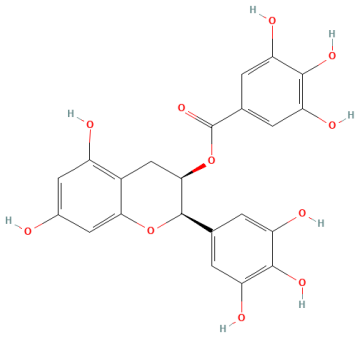
Compound data
Identifiers
- IUPAC name
- [(2R,3R)-5,7-dihydroxy-2-(3,4,5-trihydroxyphenyl)-3,4-dihydro-2H-chromen-3-yl] 3,4,5-trihydroxybenzoate
- Synonyms
- EGCG, (−)-Epigallocatechin-3-gallate, Teavigo
- InChIKey
- WMBWREPUVVBILR-WIYYLYMNSA-N
- SMILES
- C1[C@H]([C@H](OC2=CC(=CC(=C21)O)O)C3=CC(=C(C(=C3)O)O)O)OC(=O)C4=CC(=C(C(=C4)O)O)O
Properties
- Formula
- C22H18O11
- Molecular weight
- 458.4 g/mol
- Monoisotopic mass
- 458.08491139 Da
- XLogP3
- 1.2
- Polar surface area
- 197 Ų
- H-bond donors / acceptors
- 8 / 11
- Rotatable bonds
- 4
- Heavy atoms
- 33
- Formal charge
- 0
Computed by PubChem from the structure. About these values
Classification
- Mechanisms studied
- Origin
- The main catechin of green tea (Camellia sinensis) leaves
- Status
- Food or supplement
- Last reviewed
This record summarises chemistry and published research. It gives no doses, protocols or sources, and it is not a recommendation to use this compound.
Overview
EGCG is the ester of epigallocatechin with gallic acid and makes up roughly half of the catechins in green tea. It has eight phenolic hydroxyl groups, which make it a potent antioxidant in the test tube and a frequent hit in screening assays.
Mechanism
EGCG scavenges radicals, chelates metals and binds a wide range of proteins, from kinases and DNA methyltransferases to amyloid aggregates (Nagle et al., 2006). At higher concentrations it can generate hydrogen peroxide in cell culture media, which complicates the interpretation of many in-vitro results.
Research history
Catechins were characterised from tea in the 1940s, and EGCG became the main subject of green tea research from the 1980s onward, prompted by population studies of tea drinking in East Asia (Nagle et al., 2006).
Preclinical literature
Rodent studies report anti-obesity, anti-cancer and neuroprotective effects. In the ITP, a green tea extract rich in EGCG did not extend the lifespan of genetically heterogeneous mice (Strong et al., 2013).
Human research & status
Observational studies associate green tea drinking with lower cardiovascular and all-cause mortality in some cohorts; these associations may reflect lifestyle. Trials of EGCG and extracts show small metabolic effects at most. The European Food Safety Authority concluded that catechins from brewed tea are generally safe but that high intakes from supplements were associated with raised liver enzymes and occasional liver injury (EFSA Panel, Younes et al., 2018).
References
- Nagle DG, Ferreira D, Zhou YD. Epigallocatechin-3-gallate (EGCG): chemical and biomedical perspectives. Phytochemistry. 2006;67(17):1849-55. DOI PubMed
- Strong R, Miller RA, Astle CM, et al. Evaluation of resveratrol, green tea extract, curcumin, oxaloacetic acid, and medium-chain triglyceride oil on life span of genetically heterogeneous mice. J Gerontol A Biol Sci Med Sci. 2013;68(1):6-16. DOI PubMed
- EFSA Panel on Food Additives and Nutrient Sources added to Food (ANS), Younes M, Aggett P, et al. Scientific opinion on the safety of green tea catechins. EFSA J. 2018;16(4):e05239. DOI PubMed