RCD-029 Quinones & redox cofactors
Coenzyme Q10
The lipid-soluble electron carrier of the mitochondrial respiratory chain, with a ten-unit isoprenoid tail. A heart failure trial reported fewer major cardiovascular events.
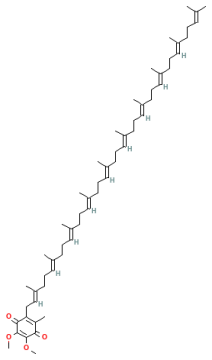
Compound data
Identifiers
- IUPAC name
- 2-[(2E,6E,10E,14E,18E,22E,26E,30E,34E)-3,7,11,15,19,23,27,31,35,39-decamethyltetraconta-2,6,10,14,18,22,26,30,34,38-decaenyl]-5,6-dimethoxy-3-methylcyclohexa-2,5-diene-1,4-dione
- Synonyms
- CoQ10, Ubiquinone-10, Ubidecarenone, Ubiquinol (reduced form)
- InChIKey
- ACTIUHUUMQJHFO-UPTCCGCDSA-N
- SMILES
- CC1=C(C(=O)C(=C(C1=O)OC)OC)C/C=C(C)/CC/C=C(C)/CC/C=C(C)/CC/C=C(C)/CC/C=C(C)/CC/C=C(C)/CC/C=C(C)/CC/C=C(C)/CC/C=C(C)/CCC=C(C)C
Properties
- Formula
- C59H90O4
- Molecular weight
- 863.3 g/mol
- Monoisotopic mass
- 862.68391135 Da
- XLogP3
- 19.4
- Polar surface area
- 52.6 Ų
- H-bond donors / acceptors
- 0 / 4
- Rotatable bonds
- 31
- Heavy atoms
- 63
- Formal charge
- 0
Computed by PubChem from the structure. About these values
Classification
- Mechanisms studied
- Origin
- Made in nearly every human cell; also in meat, fish and nuts
- First described
- 1957
- Status
- Food or supplement
- Last reviewed
This record summarises chemistry and published research. It gives no doses, protocols or sources, and it is not a recommendation to use this compound.
Overview
Coenzyme Q10 is a benzoquinone head group attached to a tail of ten isoprene units, which anchors it in the middle of the inner mitochondrial membrane. The number in its name refers to that tail length; other species use shorter tails. Its reduced form, ubiquinol, is a membrane antioxidant.
Mechanism
In the electron-transport chain, CoQ10 carries electrons from complexes I and II, and from fatty-acid oxidation, to complex III. It is also an electron acceptor for several other mitochondrial enzymes. Because it is made through the mevalonate pathway, statins lower its synthesis, which has been proposed, without conclusive evidence, as a cause of statin-associated muscle symptoms.
Research history
Frederick Crane and colleagues isolated a lipid quinone from beef-heart mitochondria in 1957 (Crane et al., 1957). Peter Mitchell’s chemiosmotic theory, which won the 1978 Nobel Prize in Chemistry, gave ubiquinone its central place in proton pumping through the Q cycle.
Preclinical literature
Supplementation extends lifespan in some invertebrate studies but not in most rodent studies, possibly because oral CoQ10 does not easily raise levels in mitochondria of most tissues. Animal studies support benefits in models of primary CoQ10 deficiency.
Human research & status
In the Q-SYMBIO trial in 420 people with chronic heart failure, two years of CoQ10 added to standard therapy reduced major adverse cardiovascular events compared with placebo (Mortensen et al., 2014). The trial was relatively small and has not been replicated at scale. CoQ10 is a standard treatment for genetic CoQ10 deficiency disorders.
References
- CRANE FL, HATEFI Y, LESTER RL, et al. Isolation of a quinone from beef heart mitochondria. Biochim Biophys Acta. 1957;25(1):220-1. DOI PubMed
- Mortensen SA, Rosenfeldt F, Kumar A, et al. The effect of coenzyme Q10 on morbidity and mortality in chronic heart failure: results from Q-SYMBIO: a randomized double-blind trial. JACC Heart Fail. 2014;2(6):641-9. DOI PubMed