RCD-039 Hormones & steroids
Melatonin
The pineal hormone that signals darkness to the body clock. Its night-time peak falls with age; trials show modest effects on sleep onset.
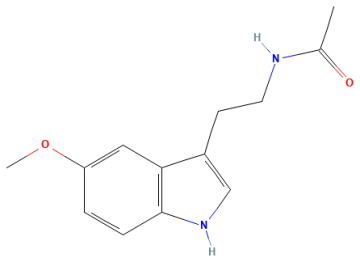
Compound data
Identifiers
- IUPAC name
- N-[2-(5-methoxy-1H-indol-3-yl)ethyl]acetamide
- Synonyms
- N-Acetyl-5-methoxytryptamine, Circadin
- InChIKey
- DRLFMBDRBRZALE-UHFFFAOYSA-N
- SMILES
- CC(=O)NCCC1=CNC2=C1C=C(C=C2)OC
Properties
- Formula
- C13H16N2O2
- Molecular weight
- 232.28 g/mol
- Monoisotopic mass
- 232.121177757 Da
- XLogP3
- 0.8
- Polar surface area
- 54.1 Ų
- H-bond donors / acceptors
- 2 / 2
- Rotatable bonds
- 4
- Heavy atoms
- 17
- Formal charge
- 0
Computed by PubChem from the structure. About these values
Classification
- Class
- Hormones & steroids
- Mechanisms studied
- Origin
- Made from serotonin in the pineal gland at night; also made in many other tissues
- First described
- 1958
- Status
- Food or supplement
- Last reviewed
This record summarises chemistry and published research. It gives no doses, protocols or sources, and it is not a recommendation to use this compound.
Overview
Melatonin is an indoleamine made from tryptophan through serotonin. The pineal gland releases it at night under control of the suprachiasmatic nucleus, and light suppresses it. Its night-time amplitude declines with age in many people (Cipolla-Neto and Amaral, 2018).
Mechanism
Melatonin acts mainly on two G-protein-coupled receptors, MT1 and MT2, which signal night to the central clock and to peripheral tissues. It also scavenges radicals directly at high concentrations and is made in mitochondria in some tissues, which has led to proposals that it protects mitochondria (Cipolla-Neto and Amaral, 2018).
Research history
Aaron Lerner and colleagues isolated melatonin from bovine pineal glands at Yale in 1958 and named it for its ability to lighten frog skin. Its role as a hormone of darkness was established in the decades that followed.
Preclinical literature
Rodent studies report effects on circadian rhythms, oxidative stress and some age-related changes, and lifespan studies in mice have given inconsistent results across strains.
Human research & status
A meta-analysis of randomised trials in primary sleep disorders found that melatonin shortened the time to fall asleep and slightly increased total sleep time, with modest effect sizes (Ferracioli-Oda et al., 2013). In the UK and EU, prolonged-release melatonin is a prescription medicine for insomnia in older adults; in the United States it is sold as a supplement, and analyses of products have found contents that differ from their labels.