RCD-010 Polyphenols & natural pigments
Fisetin
A flavonol closely related to quercetin that was the most potent senolytic in a screen of ten flavonoids. It extended mouse lifespan in one laboratory but not in the multi-site ITP.
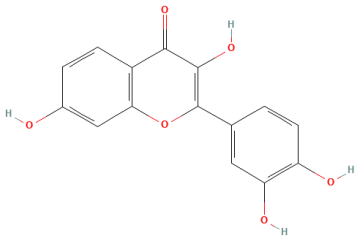
Compound data
Identifiers
- IUPAC name
- 2-(3,4-dihydroxyphenyl)-3,7-dihydroxychromen-4-one
- Synonyms
- 3,3′,4′,7-tetrahydroxyflavone, Cotinin
- InChIKey
- XHEFDIBZLJXQHF-UHFFFAOYSA-N
- SMILES
- C1=CC(=C(C=C1C2=C(C(=O)C3=C(O2)C=C(C=C3)O)O)O)O
Properties
- Formula
- C15H10O6
- Molecular weight
- 286.24 g/mol
- Monoisotopic mass
- 286.04773803 Da
- XLogP3
- 2
- Polar surface area
- 107 Ų
- H-bond donors / acceptors
- 4 / 6
- Rotatable bonds
- 1
- Heavy atoms
- 21
- Formal charge
- 0
Computed by PubChem from the structure. About these values
Classification
- Mechanisms studied
- Origin
- Flavonol found in strawberries, apples, persimmons and the smoke tree (Cotinus coggygria)
- Status
- Food or supplement
- Last reviewed
This record summarises chemistry and published research. It gives no doses, protocols or sources, and it is not a recommendation to use this compound.
Overview
Fisetin differs from quercetin only by lacking the hydroxyl group at position 5. It is found at low levels in fruit and vegetables, with strawberries the richest common source. It became a focus of aging research when it was identified as a single-agent senolytic.
Mechanism
In cultured senescent human endothelial cells, fisetin selectively induced apoptosis, an effect attributed to inhibition of the PI3K/AKT survival pathway and other senescent-cell survival networks (Zhu et al., 2017). Its activity varies by cell type, and it was not senolytic in every senescent cell model tested.
Research history
Fisetin was first described in the late nineteenth century as a yellow dye from the smoke tree. It was studied as an antioxidant and neuroprotective flavonoid before the senolytic screens of the 2010s.
Preclinical literature
Yousefzadeh and colleagues screened ten flavonoids and found fisetin the most potent senolytic. In progeroid and naturally aged mice, fisetin reduced senescence markers in several tissues and, given late in life, extended median and maximal lifespan (Yousefzadeh et al., 2018). The Interventions Testing Program later tested fisetin in genetically heterogeneous mice and found no significant lifespan extension in either sex (Harrison et al., 2024), a reminder that single-laboratory lifespan results do not always replicate.
Human research & status
Several placebo-controlled trials of intermittent fisetin in older adults and in specific conditions are registered. As of the last review of this record, peer-reviewed efficacy results were limited. Fisetin is poorly water-soluble and has low oral bioavailability.
References
- Zhu Y, Doornebal EJ, Pirtskhalava T, et al. New agents that target senescent cells: the flavone, fisetin, and the BCL-X(L) inhibitors, A1331852 and A1155463. Aging (Albany NY). 2017;9(3):955-963. DOI PubMed
- Yousefzadeh MJ, Zhu Y, McGowan SJ, et al. Fisetin is a senotherapeutic that extends health and lifespan. EBioMedicine. 2018;36:18-28. DOI PubMed
- Harrison DE, Strong R, Reifsnyder P, et al. Astaxanthin and meclizine extend lifespan in UM-HET3 male mice; fisetin, SG1002 (hydrogen sulfide donor), dimethyl fumarate, mycophenolic acid, and 4-phenylbutyrate do not significantly affect lifespan in either sex at the doses and schedules used. Geroscience. 2024;46(1):795-816. DOI PubMed