RCD-044 Peptides
Epitalon
A tetrapeptide from the St Petersburg peptide-bioregulator programme. Reports of telomerase activation and longer life in mice come mainly from the originating group.
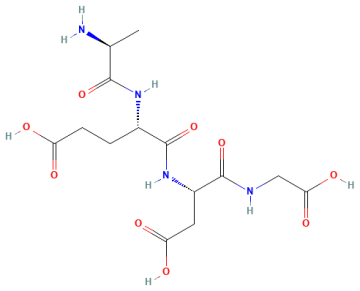
Compound data
Identifiers
- IUPAC name
- (4S)-4-[[(2S)-2-aminopropanoyl]amino]-5-[[(2S)-3-carboxy-1-(carboxymethylamino)-1-oxopropan-2-yl]amino]-5-oxopentanoic acid
- Synonyms
- Epithalon, Epithalone, AEDG peptide, Ala-Glu-Asp-Gly
- InChIKey
- HGHOBRRUMWJWCU-FXQIFTODSA-N
- SMILES
- C[C@@H](C(=O)N[C@@H](CCC(=O)O)C(=O)N[C@@H](CC(=O)O)C(=O)NCC(=O)O)N
- Sequence
- AEDG
Properties
- Formula
- C14H22N4O9
- Molecular weight
- 390.35 g/mol
- Monoisotopic mass
- 390.13867829 Da
- XLogP3
- -5.5
- Polar surface area
- 225 Ų
- H-bond donors / acceptors
- 7 / 10
- Rotatable bonds
- 12
- Heavy atoms
- 27
- Formal charge
- 0
Computed by PubChem from the structure. About these values
Classification
- Class
- Peptides
- Mechanisms studied
- Origin
- Synthetic tetrapeptide modelled on epithalamin, a bovine pineal extract
- Status
- Research compound
- Last reviewed
This record summarises chemistry and published research. It gives no doses, protocols or sources, and it is not a recommendation to use this compound.
Overview
Epitalon is the tetrapeptide alanyl-glutamyl-aspartyl-glycine. It was designed as a synthetic counterpart of epithalamin, a polypeptide extract of bovine pineal glands, within the “peptide bioregulator” programme led by Vladimir Khavinson in St Petersburg.
Mechanism
Khavinson and colleagues reported that epitalon induced telomerase activity and telomere elongation in cultured human fibroblasts (Khavinson et al., 2003). Other proposed actions include effects on melatonin rhythms and on gene expression through direct binding to DNA. These mechanisms have not been confirmed by independent laboratories.
Research history
Epithalamin was developed in the Soviet Union in the 1980s, and epitalon followed in the 1990s. Most of the literature is from the originating institute and collaborating groups.
Preclinical literature
In female SHR mice, epitalon slowed some age-related changes in reproductive function, did not change mean lifespan significantly, increased the lifespan of the last 10 percent of survivors, and reduced leukaemia incidence (Anisimov et al., 2003). Results in other strains and species are sparse.
Human research & status
Publications from the originating group describe studies in older people, but these do not meet current standards for randomised controlled trials and have not been independently reproduced. Epitalon is not approved as a medicine.
References
- Khavinson VKh, Bondarev IE, Butyugov AA. Epithalon peptide induces telomerase activity and telomere elongation in human somatic cells. Bull Exp Biol Med. 2003;135(6):590-2. DOI PubMed
- Anisimov VN, Khavinson VKh, Popovich IG, et al. Effect of Epitalon on biomarkers of aging, life span and spontaneous tumor incidence in female Swiss-derived SHR mice. Biogerontology. 2003;4(4):193-202. DOI PubMed