RCD-009 Polyphenols & natural pigments
Quercetin
One of the most common dietary flavonoids, studied for decades as an antioxidant and now as the "Q" in the dasatinib-plus-quercetin senolytic combination.
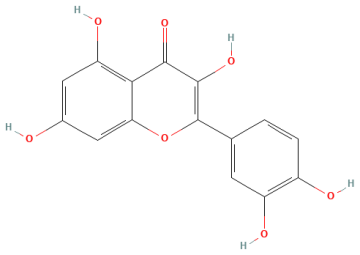
Compound data
Identifiers
- IUPAC name
- 2-(3,4-dihydroxyphenyl)-3,5,7-trihydroxychromen-4-one
- Synonyms
- Sophoretin, Meletin, 3,3′,4′,5,7-pentahydroxyflavone
- InChIKey
- REFJWTPEDVJJIY-UHFFFAOYSA-N
- SMILES
- C1=CC(=C(C=C1C2=C(C(=O)C3=C(C=C(C=C3O2)O)O)O)O)O
Properties
- Formula
- C15H10O7
- Molecular weight
- 302.23 g/mol
- Monoisotopic mass
- 302.04265265 Da
- XLogP3
- 1.5
- Polar surface area
- 127 Ų
- H-bond donors / acceptors
- 5 / 7
- Rotatable bonds
- 1
- Heavy atoms
- 22
- Formal charge
- 0
Computed by PubChem from the structure. About these values
Classification
- Mechanisms studied
- Origin
- Flavonol found in onions, apples, capers, tea and many other plants, mostly as glycosides
- Status
- Food or supplement
- Last reviewed
This record summarises chemistry and published research. It gives no doses, protocols or sources, and it is not a recommendation to use this compound.
Overview
Quercetin is a flavonol, a flavonoid with a hydroxyl group at position 3 of the C ring. In plants it occurs mostly as glycosides such as rutin and isoquercitrin, which are hydrolysed in the gut before absorption. It is one of the most abundant flavonoids in the human diet.
Mechanism
Quercetin is a strong radical scavenger and metal chelator in vitro, and it inhibits many enzymes, including kinases such as PI3K, at micromolar concentrations (Boots et al., 2008). Its senolytic activity was found in a screen for compounds that block senescent cell anti-apoptotic pathways; quercetin was more effective against senescent human endothelial cells than against fat-cell progenitors, the reverse of dasatinib (Zhu et al., 2015). Like many flavonoids, it can interfere with assays and binds many proteins non-specifically, so single-target explanations should be treated with caution.
Research history
Albert Szent-Györgyi’s work on citrus flavonoids in the 1930s, which he briefly called “vitamin P”, started the modern interest in flavonoids. Quercetin has been studied since as an antioxidant, anti-inflammatory and antiproliferative agent, mostly in cell culture (Boots et al., 2008).
Preclinical literature
Alone, quercetin has a large in-vitro literature and a smaller, inconsistent animal literature. Combined with dasatinib, it reduced senescent cell burden and improved physical function in aged mice and increased remaining lifespan when started very late in life (Xu et al., 2018).
Human research & status
Oral quercetin has low and variable bioavailability, and most circulating quercetin is present as glucuronide and sulfate conjugates. Human senolytic data come from small pilot studies of the dasatinib-plus-quercetin combination, which cannot separate the contribution of each compound (Justice et al., 2019; Hickson et al., 2019).
References
- Boots AW, Haenen GR, Bast A. Health effects of quercetin: from antioxidant to nutraceutical. Eur J Pharmacol. 2008;585(2-3):325-37. DOI PubMed
- Zhu Y, Tchkonia T, Pirtskhalava T, et al. The Achilles' heel of senescent cells: from transcriptome to senolytic drugs. Aging Cell. 2015;14(4):644-58. DOI PubMed
- Xu M, Pirtskhalava T, Farr JN, et al. Senolytics improve physical function and increase lifespan in old age. Nat Med. 2018;24(8):1246-1256. DOI PubMed
- Justice JN, Nambiar AM, Tchkonia T, et al. Senolytics in idiopathic pulmonary fibrosis: Results from a first-in-human, open-label, pilot study. EBioMedicine. 2019;40:554-563. DOI PubMed
- Hickson LJ, Langhi Prata LGP, Bobart SA, et al. Senolytics decrease senescent cells in humans: Preliminary report from a clinical trial of Dasatinib plus Quercetin in individuals with diabetic kidney disease. EBioMedicine. 2019;47:446-456. DOI PubMed