RCD-004 Synthetic small molecules
Canagliflozin
An SGLT2 inhibitor that lowers blood glucose by making the kidney excrete it. In the Interventions Testing Program it extended lifespan in male mice but not in females.
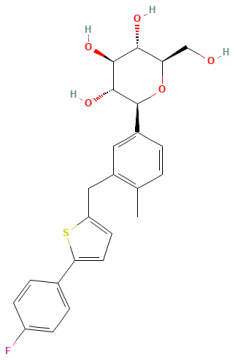
Compound data
Identifiers
- IUPAC name
- (2S,3R,4R,5S,6R)-2-[3-[[5-(4-fluorophenyl)thiophen-2-yl]methyl]-4-methylphenyl]-6-(hydroxymethyl)oxane-3,4,5-triol
- Synonyms
- JNJ-28431754, TA-7284, Invokana
- InChIKey
- XTNGUQKDFGDXSJ-ZXGKGEBGSA-N
- SMILES
- CC1=C(C=C(C=C1)[C@H]2[C@@H]([C@H]([C@@H]([C@H](O2)CO)O)O)O)CC3=CC=C(S3)C4=CC=C(C=C4)F
Properties
- Formula
- C24H25FO5S
- Molecular weight
- 444.5 g/mol
- Monoisotopic mass
- 444.14067323 Da
- XLogP3
- 3.2
- Polar surface area
- 118 Ų
- H-bond donors / acceptors
- 4 / 7
- Rotatable bonds
- 5
- Heavy atoms
- 31
- Formal charge
- 0
Computed by PubChem from the structure. About these values
Classification
- Mechanisms studied
- Origin
- Synthetic C-glucoside, designed from the apple-bark glucoside phlorizin
- First described
- 2010
- Status
- Approved medicine
- Last reviewed
This record summarises chemistry and published research. It gives no doses, protocols or sources, and it is not a recommendation to use this compound.
Overview
Canagliflozin belongs to the gliflozins, inhibitors of sodium–glucose cotransporter 2 (SGLT2). The class was designed from phlorizin, a glucoside found in apple-tree bark that blocks glucose reabsorption in the kidney but is poorly absorbed and unselective. Canagliflozin is a C-glucoside, which makes it resistant to breakdown by intestinal glucosidases.
Mechanism
SGLT2 in the proximal tubule reabsorbs most of the glucose filtered by the kidney. Blocking it lowers the renal threshold for glucose, so excess glucose is lost in urine. This reduces blood glucose and insulin levels independently of insulin action, causes a small calorie loss and shifts metabolism slightly towards fat oxidation and ketone production. Canagliflozin also has weaker activity at SGLT1.
Research history
Canagliflozin was the first SGLT2 inhibitor approved in the United States, in 2013. The CANVAS programme, two trials in more than 10,000 people with type 2 diabetes and high cardiovascular risk, found fewer major cardiovascular events than placebo, alongside a higher risk of amputation (Neal et al., 2017). Later trials across the class extended its use to heart failure and chronic kidney disease.
Preclinical literature
The ITP fed canagliflozin to genetically heterogeneous mice from seven months of age. Median lifespan increased by 14 percent in males, with no lifespan benefit in females, although treated females gained less weight with age (Miller et al., 2020). The male-specific pattern resembles that of acarbose and 17α-estradiol, two other ITP compounds that blunt post-meal glucose peaks, which has prompted work on sex differences in how mice respond to glucose control.
Human research & status
Human evidence comes from diabetes and cardiorenal outcome trials, not from studies of aging. Known risks of the class include genital fungal infections, volume depletion and, rarely, ketoacidosis with near-normal glucose. Canagliflozin is a prescription medicine.
References
- Neal B, Perkovic V, Mahaffey KW, et al. Canagliflozin and Cardiovascular and Renal Events in Type 2 Diabetes. N Engl J Med. 2017;377(7):644-657. DOI PubMed
- Miller RA, Harrison DE, Allison DB, et al. Canagliflozin extends life span in genetically heterogeneous male but not female mice. JCI Insight. 2020;5(21). DOI PubMed
- Harrison DE, Strong R, Allison DB, et al. Acarbose, 17-α-estradiol, and nordihydroguaiaretic acid extend mouse lifespan preferentially in males. Aging Cell. 2014;13(2):273-82. DOI PubMed