RCD-019 Alkaloids
Piperlongumine
A long-pepper alkaloid with two Michael-acceptor groups that raises oxidative stress in vulnerable cells. It is senolytic in culture, and the most-cited paper on its anti-cancer selectivity was retracted.
Compound data
Identifiers
- IUPAC name
- 1-[(E)-3-(3,4,5-trimethoxyphenyl)prop-2-enoyl]-2,3-dihydropyridin-6-one
- Synonyms
- Piplartine
- InChIKey
- VABYUUZNAVQNPG-BQYQJAHWSA-N
- SMILES
- COC1=CC(=CC(=C1OC)OC)/C=C/C(=O)N2CCC=CC2=O
Properties
- Formula
- C17H19NO5
- Molecular weight
- 317.34 g/mol
- Monoisotopic mass
- 317.12632271 Da
- XLogP3
- 2.1
- Polar surface area
- 65.1 Ų
- H-bond donors / acceptors
- 0 / 5
- Rotatable bonds
- 5
- Heavy atoms
- 23
- Formal charge
- 0
Computed by PubChem from the structure. About these values
Classification
- Class
- Alkaloids
- Mechanisms studied
- Origin
- Amide alkaloid from long pepper (Piper longum)
- Status
- Research compound
- Last reviewed
This record summarises chemistry and published research. It gives no doses, protocols or sources, and it is not a recommendation to use this compound.
Overview
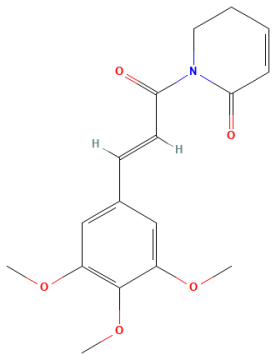
Piperlongumine is a trimethoxycinnamoyl amide of a dihydropyridinone. It contains two α,β-unsaturated carbonyl groups that can react covalently with thiols, including glutathione and cysteine residues in proteins. This reactivity underlies most of its biological activity.
Mechanism
By depleting glutathione and modifying redox-regulating proteins, piperlongumine raises reactive oxygen species. Cells with high baseline oxidative stress, including many cancer cells and senescent cells, are pushed past a threshold into apoptosis more readily than normal cells (Wang et al., 2016).
Research history
A 2011 Nature paper reported that piperlongumine selectively killed cancer cells by targeting the stress response to ROS and drew wide attention (Raj et al., 2011). That paper was corrected twice and retracted in 2018. The broader observation that piperlongumine raises ROS has been reproduced, but the specific claims of that paper should not be relied on.
Preclinical literature
Wang and colleagues screened natural products for senolytic activity and found that piperlongumine killed senescent human fibroblasts and acted synergistically with navitoclax (ABT-263) (Wang et al., 2016). Its activity varied with the type of senescence and the cell type. Animal data on senescence are limited.
Human research & status
There are no clinical studies. Piperlongumine is used as a research tool and as a starting point for designing more selective senolytics.
References
- Raj L, Ide T, Gurkar AU, et al. Selective killing of cancer cells by a small molecule targeting the stress response to ROS. Nature. 2011;475(7355):231-4. Retracted in 2018 (Nature 561:420). DOI PubMed
- Wang Y, Chang J, Liu X, et al. Discovery of piperlongumine as a potential novel lead for the development of senolytic agents. Aging (Albany NY). 2016;8(11):2915-2926. DOI PubMed