RCD-047 Peptides
Semax
A heptapeptide analogue of an ACTH fragment with a Pro-Gly-Pro tail added for stability. It raises BDNF in the rat brain and is used in Russia for stroke recovery.
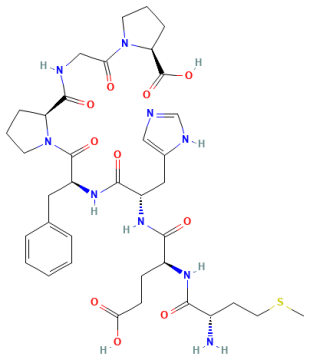
Compound data
Identifiers
- IUPAC name
- (2S)-1-[2-[[(2S)-1-[(2S)-2-[[(2S)-2-[[(2S)-2-[[(2S)-2-amino-4-methylsulfanylbutanoyl]amino]-4-carboxybutanoyl]amino]-3-(1H-imidazol-5-yl)propanoyl]amino]-3-phenylpropanoyl]pyrrolidine-2-carbonyl]amino]acetyl]pyrrolidine-2-carboxylic acid
- Synonyms
- ACTH(4–7)-Pro-Gly-Pro, Met-Glu-His-Phe-Pro-Gly-Pro
- InChIKey
- AFEHBIGDWIGTEH-AQRCPPRCSA-N
- SMILES
- CSCC[C@@H](C(=O)N[C@@H](CCC(=O)O)C(=O)N[C@@H](CC1=CN=CN1)C(=O)N[C@@H](CC2=CC=CC=C2)C(=O)N3CCC[C@H]3C(=O)NCC(=O)N4CCC[C@H]4C(=O)O)N
- Sequence
- MEHFPGP
Properties
- Formula
- C37H51N9O10S
- Molecular weight
- 813.9 g/mol
- Monoisotopic mass
- 813.34796003 Da
- XLogP3
- -2.8
- Polar surface area
- 312 Ų
- H-bond donors / acceptors
- 8 / 13
- Rotatable bonds
- 21
- Heavy atoms
- 57
- Formal charge
- 0
Computed by PubChem from the structure. About these values
Classification
- Class
- Peptides
- Mechanisms studied
- Origin
- Synthetic heptapeptide based on adrenocorticotropic hormone residues 4 to 7
- Status
- Research compound
- Last reviewed
This record summarises chemistry and published research. It gives no doses, protocols or sources, and it is not a recommendation to use this compound.
Overview
Semax joins the ACTH(4–7) fragment, Met-Glu-His-Phe, to the tripeptide Pro-Gly-Pro. ACTH fragments affect attention and learning in animals without stimulating the adrenal glands, but they are broken down within minutes; the added tail slows that breakdown.
Mechanism
In the rat hippocampus, Semax increased expression of brain-derived neurotrophic factor (BDNF) and of its receptor TrkB (Dolotov et al., 2006). It also changes the expression of genes involved in immune and vascular responses after experimental stroke. Its receptor is not known.
Research history
Semax was developed in the 1980s at the Institute of Molecular Genetics of the Russian Academy of Sciences, together with Moscow State University. It is given as nasal drops and is registered in Russia for stroke, cognitive disorders and some eye conditions.
Preclinical literature
Rodent studies report improved learning, neuroprotection in models of ischaemia and changes in dopamine and serotonin systems, mostly from Russian laboratories.
Human research & status
Clinical studies have been published mainly in Russian journals, with small samples and limited blinding. It has not been evaluated by the FDA or the EMA.