RCD-015 Polyphenols & natural pigments
Nordihydroguaiaretic acid
A plant lignan and former food antioxidant that extended lifespan in male, but not female, genetically heterogeneous mice in two ITP studies. Kidney and liver toxicity limit its use.
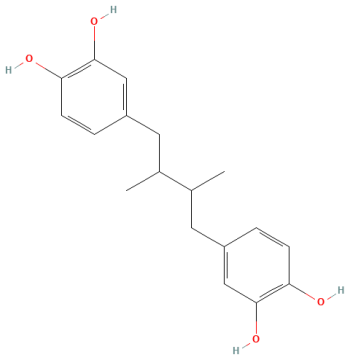
Compound data
Identifiers
- IUPAC name
- 4-[4-(3,4-dihydroxyphenyl)-2,3-dimethylbutyl]benzene-1,2-diol
- Synonyms
- NDGA, Masoprocol, Actinex
- InChIKey
- HCZKYJDFEPMADG-UHFFFAOYSA-N
- SMILES
- CC(CC1=CC(=C(C=C1)O)O)C(C)CC2=CC(=C(C=C2)O)O
Properties
- Formula
- C18H22O4
- Molecular weight
- 302.4 g/mol
- Monoisotopic mass
- 302.15180918 Da
- XLogP3
- 4.3
- Polar surface area
- 80.9 Ų
- H-bond donors / acceptors
- 4 / 4
- Rotatable bonds
- 5
- Heavy atoms
- 22
- Formal charge
- 0
Computed by PubChem from the structure. About these values
Classification
- Mechanisms studied
- Origin
- Lignan from the creosote bush (Larrea tridentata), the source of chaparral tea
- Status
- Research compound
- Last reviewed
This record summarises chemistry and published research. It gives no doses, protocols or sources, and it is not a recommendation to use this compound.
Overview
NDGA is a catechol lignan: two catechol rings joined by a dimethylbutane bridge. It was widely used to stop fats and oils going rancid until animal studies showed kidney cysts, and it is the main active compound in chaparral, a herbal product linked to liver injury (Manda et al., 2020).
Mechanism
NDGA is a strong antioxidant and an inhibitor of lipoxygenases, which make inflammatory lipid mediators. It also inhibits receptor tyrosine kinases such as IGF-1R and activates NRF2. Oxidation of its catechols produces reactive quinones, which likely explain both some of its activity and its toxicity (Manda et al., 2020).
Research history
NDGA was introduced as a food antioxidant in the 1940s. A topical preparation, masoprocol, was approved in the United States in 1992 for actinic keratoses and later discontinued. Derivatives such as terameprocol have been tested in cancer.
Preclinical literature
NDGA was one of the first positive results from the Interventions Testing Program: it increased median lifespan in male genetically heterogeneous mice, with no effect in females (Strong et al., 2008). A later cohort confirmed the male-only effect at higher concentrations (Harrison et al., 2014). The sex difference was not explained by differences in blood levels of the drug.
Human research & status
There are no aging studies in people. Case reports link chaparral products to serious liver injury, and NDGA is not considered safe to use as a food ingredient.
References
- Strong R, Miller RA, Astle CM, et al. Nordihydroguaiaretic acid and aspirin increase lifespan of genetically heterogeneous male mice. Aging Cell. 2008;7(5):641-50. DOI PubMed
- Harrison DE, Strong R, Allison DB, et al. Acarbose, 17-α-estradiol, and nordihydroguaiaretic acid extend mouse lifespan preferentially in males. Aging Cell. 2014;13(2):273-82. DOI PubMed
- Manda G, Rojo AI, Martínez-Klimova E, et al. Nordihydroguaiaretic Acid: From Herbal Medicine to Clinical Development for Cancer and Chronic Diseases. Front Pharmacol. 2020;11:151. DOI PubMed