RCD-021 Nucleotides & NAD+ precursors
Nicotinamide riboside
A form of vitamin B3 that cells convert to NMN and then NAD+ through nicotinamide riboside kinases. It raises blood NAD+ in people and is well tolerated in short trials.
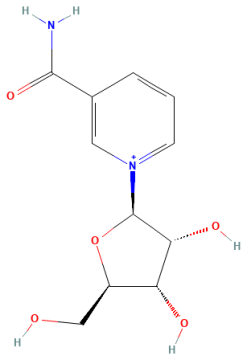
Compound data
Identifiers
- IUPAC name
- 1-[(2R,3R,4S,5R)-3,4-dihydroxy-5-(hydroxymethyl)oxolan-2-yl]pyridin-1-ium-3-carboxamide
- Synonyms
- NR, Nicotinamide riboside chloride (NRCl), Niagen
- InChIKey
- JLEBZPBDRKPWTD-TURQNECASA-O
- SMILES
- C1=CC(=C[N+](=C1)[C@H]2[C@@H]([C@@H]([C@H](O2)CO)O)O)C(=O)N
Properties
- Formula
- C11H15N2O5+
- Molecular weight
- 255.25 g/mol
- Monoisotopic mass
- 255.09809658 Da
- XLogP3
- -1.8
- Polar surface area
- 117 Ų
- H-bond donors / acceptors
- 4 / 5
- Rotatable bonds
- 3
- Heavy atoms
- 18
- Formal charge
- 1
Computed by PubChem from the structure. About these values
Classification
- Mechanisms studied
- Origin
- Vitamin B3 nucleoside found in trace amounts in milk; produced synthetically
- First described
- 2004
- Status
- Food or supplement
- Last reviewed
This record summarises chemistry and published research. It gives no doses, protocols or sources, and it is not a recommendation to use this compound.
Overview
Nicotinamide riboside is the nucleoside counterpart of NMN, without the phosphate. Its positively charged pyridinium ring is why PubChem lists it as a cation; commercial products use the chloride salt.
Mechanism
Bieganowski and Brenner showed that NR is a nutrient that enters NAD+ synthesis through nicotinamide riboside kinases (NRK1 and NRK2), which phosphorylate it to NMN. This route is separate from both the salvage pathway through NAMPT and the Preiss–Handler pathway from nicotinic acid (Bieganowski and Brenner, 2004). In vivo, a large part of oral NR is broken down to nicotinamide before it reaches tissues.
Research history
The 2004 discovery of the NRK pathway led to NR being developed as a supplement. It was among the first NAD+ precursors tested in controlled human trials.
Preclinical literature
In mice, NR raised hepatic NAD+ more effectively than nicotinamide or nicotinic acid in a single-dose comparison (Trammell et al., 2016). Rodent studies report protection against diet-induced obesity, improved mitochondrial function and muscle stem cell function, and benefits in models of neurodegeneration and hearing loss (Rajman et al., 2018).
Human research & status
Single doses of NR raised the blood NAD+ metabolome in a healthy volunteer and in a pharmacokinetic study (Trammell et al., 2016). In a six-week crossover trial in healthy middle-aged and older adults, NR was well tolerated and raised NAD+ in blood cells; blood pressure and arterial stiffness showed trends that need confirmation (Martens et al., 2018). Most trials since have found reliable NAD+ increases with small or no functional effects.
References
- Bieganowski P, Brenner C. Discoveries of nicotinamide riboside as a nutrient and conserved NRK genes establish a Preiss-Handler independent route to NAD+ in fungi and humans. Cell. 2004;117(4):495-502. DOI PubMed
- Trammell SA, Schmidt MS, Weidemann BJ, et al. Nicotinamide riboside is uniquely and orally bioavailable in mice and humans. Nat Commun. 2016;7:12948. DOI PubMed
- Martens CR, Denman BA, Mazzo MR, et al. Chronic nicotinamide riboside supplementation is well-tolerated and elevates NAD(+) in healthy middle-aged and older adults. Nat Commun. 2018;9(1):1286. DOI PubMed
- Rajman L, Chwalek K, Sinclair DA. Therapeutic Potential of NAD-Boosting Molecules: The In Vivo Evidence. Cell Metab. 2018;27(3):529-547. DOI PubMed