RCD-002 Macrolides & rapalogs
Everolimus
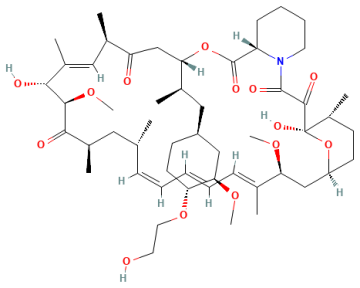
A semi-synthetic rapamycin analogue (a "rapalog") with a hydroxyethyl group at position 40. It was the compound used in the first trial of mTOR inhibition on immune aging in older adults.
Compound data
Identifiers
- IUPAC name
- (1R,9S,12S,15R,16E,18R,19R,21R,23S,24E,26E,28E,30S,32S,35R)-1,18-dihydroxy-12-[(2R)-1-[(1S,3R,4R)-4-(2-hydroxyethoxy)-3-methoxycyclohexyl]propan-2-yl]-19,30-dimethoxy-15,17,21,23,29,35-hexamethyl-11,36-dioxa-4-azatricyclo[30.3.1.04,9]hexatriaconta-16,24,26,28-tetraene-2,3,10,14,20-pentone
- Synonyms
- RAD001, SDZ RAD, 40-O-(2-hydroxyethyl)-rapamycin, Afinitor, Zortress
- InChIKey
- HKVAMNSJSFKALM-GKUWKFKPSA-N
- SMILES
- C[C@@H]1CC[C@H]2C[C@@H](/C(=C/C=C/C=C/[C@H](C[C@H](C(=O)[C@@H]([C@@H](/C(=C/[C@H](C(=O)C[C@H](OC(=O)[C@@H]3CCCCN3C(=O)C(=O)[C@@]1(O2)O)[C@H](C)C[C@@H]4CC[C@H]([C@@H](C4)OC)OCCO)C)/C)O)OC)C)C)/C)OC
Properties
- Formula
- C53H83NO14
- Molecular weight
- 958.2 g/mol
- Monoisotopic mass
- 957.58135632 Da
- XLogP3
- 5.9
- Polar surface area
- 205 Ų
- H-bond donors / acceptors
- 3 / 14
- Rotatable bonds
- 9
- Heavy atoms
- 68
- Formal charge
- 0
Computed by PubChem from the structure. About these values
Classification
- Mechanisms studied
- Origin
- Semi-synthetic derivative of rapamycin
- First described
- 1997
- Status
- Approved medicine
- Last reviewed
This record summarises chemistry and published research. It gives no doses, protocols or sources, and it is not a recommendation to use this compound.
Overview
Everolimus is rapamycin with a 2-hydroxyethyl ether at the C-40 hydroxyl. The change was made to improve the pharmacokinetic profile of the parent molecule, giving better oral absorption and a shorter half-life, while keeping the same binding mode. It belongs to a family of rapamycin derivatives known as rapalogs, which also includes temsirolimus and ridaforolimus.
Mechanism
Like rapamycin, everolimus forms a complex with FKBP12 that allosterically inhibits mTOR complex 1 (Saxton and Sabatini, 2017). It reduces phosphorylation of the mTORC1 substrates S6 kinase and 4E-BP1, slowing protein synthesis and cell proliferation. Because it shares the binding site, everolimus is used in research as a pharmacological probe of mTORC1 in the same way as rapamycin.
Research history
Schuler and colleagues at Sandoz (later Novartis) described the compound, then called SDZ RAD, in 1997 and reported its immunosuppressive activity in cells and in animal transplant models (Schuler et al., 1997). It was approved in Europe for transplant rejection and, from 2009 in the United States, for advanced renal cell carcinoma, followed by approvals in breast cancer, neuroendocrine tumours and tuberous sclerosis complex.
Preclinical literature
Everolimus has not been through the ITP lifespan programme, and most of its preclinical literature is in oncology and transplantation. Its aging relevance rests on the shared mechanism with rapamycin and on the conservation of reduced mTORC1 signalling as a longevity intervention across species.
Human research & status
In a placebo-controlled study in adults aged 65 and over, six weeks of everolimus before influenza vaccination improved the antibody response by about 20 percent and reduced the proportion of PD-1-positive T cells, a marker associated with immune exhaustion (Mannick et al., 2014). A follow-up trial with RAD001 alone or combined with the catalytic mTOR inhibitor BEZ235 reported upregulated antiviral gene expression and fewer self-reported infections over a year (Mannick et al., 2018). These were short studies with immune end points; they do not show an effect on aging itself.
References
- Schuler W, Sedrani R, Cottens S, et al. SDZ RAD, a new rapamycin derivative: pharmacological properties in vitro and in vivo. Transplantation. 1997;64(1):36-42. DOI PubMed
- Saxton RA, Sabatini DM. mTOR Signaling in Growth, Metabolism, and Disease. Cell. 2017;169(2):361-371. DOI PubMed
- Mannick JB, Del Giudice G, Lattanzi M, et al. mTOR inhibition improves immune function in the elderly. Sci Transl Med. 2014;6(268):268ra179. DOI PubMed
- Mannick JB, Morris M, Hockey HP, et al. TORC1 inhibition enhances immune function and reduces infections in the elderly. Sci Transl Med. 2018;10(449). DOI PubMed