RCD-046 Peptides
KPV
The last three amino acids of α-MSH. It enters gut cells through the PepT1 transporter and reduces intestinal inflammation in mouse colitis models.
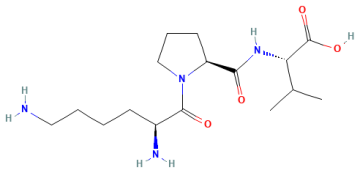
Compound data
Identifiers
- IUPAC name
- (2S)-2-[[(2S)-1-[(2S)-2,6-diaminohexanoyl]pyrrolidine-2-carbonyl]amino]-3-methylbutanoic acid
- Synonyms
- Lys-Pro-Val, L-Lysyl-L-prolyl-L-valine, α-MSH(11–13)
- InChIKey
- YSPZCHGIWAQVKQ-AVGNSLFASA-N
- SMILES
- CC(C)[C@@H](C(=O)O)NC(=O)[C@@H]1CCCN1C(=O)[C@H](CCCCN)N
- Sequence
- KPV
Properties
- Formula
- C16H30N4O4
- Molecular weight
- 342.43 g/mol
- Monoisotopic mass
- 342.22670545 Da
- XLogP3
- -3.5
- Polar surface area
- 139 Ų
- H-bond donors / acceptors
- 4 / 6
- Rotatable bonds
- 9
- Heavy atoms
- 24
- Formal charge
- 0
Computed by PubChem from the structure. About these values
Classification
- Class
- Peptides
- Mechanisms studied
- Origin
- C-terminal tripeptide of alpha-melanocyte-stimulating hormone (α-MSH)
- Status
- Research compound
- Last reviewed
This record summarises chemistry and published research. It gives no doses, protocols or sources, and it is not a recommendation to use this compound.
Overview
KPV is the tripeptide lysyl-prolyl-valine, residues 11 to 13 of α-melanocyte-stimulating hormone, a hormone with broad anti-inflammatory effects. KPV keeps much of that anti-inflammatory activity without the pigmentary effects of the full hormone.
Mechanism
Dalmasso and colleagues found that KPV is taken up by intestinal epithelial cells and immune cells through the peptide transporter PepT1, which is increased in inflamed colon, and that inside cells it inhibits NF-κB and MAP kinase inflammatory signalling (Dalmasso et al., 2008). Whether it also acts through melanocortin receptors is unclear.
Research history
Anti-inflammatory activity of α-MSH fragments was described in the 1980s and 1990s. Interest in KPV for inflammatory bowel disease grew from 2008.
Preclinical literature
In two mouse models of colitis, KPV reduced weight loss, inflammatory cell infiltration and cytokine expression (Kannengiesser et al., 2008; Dalmasso et al., 2008). Nanoparticle formulations have been studied for targeted delivery to the colon.
Human research & status
There are no published controlled human trials. KPV is not approved as a medicine.
References
- Dalmasso G, Charrier-Hisamuddin L, Nguyen HT, et al. PepT1-mediated tripeptide KPV uptake reduces intestinal inflammation. Gastroenterology. 2008;134(1):166-78. DOI PubMed
- Kannengiesser K, Maaser C, Heidemann J, et al. Melanocortin-derived tripeptide KPV has anti-inflammatory potential in murine models of inflammatory bowel disease. Inflamm Bowel Dis. 2008;14(3):324-31. DOI PubMed