RCD-045 Peptides
Elamipretide
A mitochondria-targeted tetrapeptide that binds cardiolipin in the inner membrane. It improved muscle energetics in old mice and became the first approved treatment for Barth syndrome.
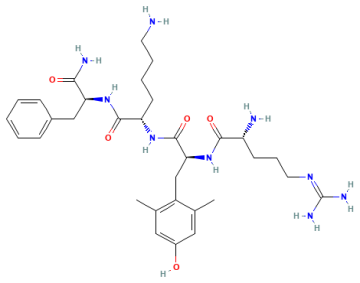
Compound data
Identifiers
- IUPAC name
- (2S)-6-amino-2-[[(2S)-2-[[(2R)-2-amino-5-(diaminomethylideneamino)pentanoyl]amino]-3-(4-hydroxy-2,6-dimethylphenyl)propanoyl]amino]-N-[(2S)-1-amino-1-oxo-3-phenylpropan-2-yl]hexanamide
- Synonyms
- SS-31, MTP-131, Bendavia, Forzinity, D-Arg-Dmt-Lys-Phe-NH2
- InChIKey
- SFVLTCAESLKEHH-WKAQUBQDSA-N
- SMILES
- CC1=CC(=CC(=C1C[C@@H](C(=O)N[C@@H](CCCCN)C(=O)N[C@@H](CC2=CC=CC=C2)C(=O)N)NC(=O)[C@@H](CCCN=C(N)N)N)C)O
- Sequence
- r-Dmt-K-F-NH2
Properties
- Formula
- C32H49N9O5
- Molecular weight
- 639.8 g/mol
- Monoisotopic mass
- 639.38566570 Da
- XLogP3
- 0
- Polar surface area
- 267 Ų
- H-bond donors / acceptors
- 9 / 8
- Rotatable bonds
- 19
- Heavy atoms
- 46
- Formal charge
- 0
Computed by PubChem from the structure. About these values
Classification
- Class
- Peptides
- Mechanisms studied
- Origin
- Synthetic tetrapeptide with a D-arginine and 2′,6′-dimethyltyrosine
- First described
- 2004
- Status
- Approved medicine
- Last reviewed
This record summarises chemistry and published research. It gives no doses, protocols or sources, and it is not a recommendation to use this compound.
Overview
Elamipretide belongs to the Szeto–Schiller (SS) peptides, short aromatic–cationic peptides that concentrate in the inner mitochondrial membrane without depending on membrane potential. Its alternating positive charges and aromatic rings, and its D-amino acid and unnatural dimethyltyrosine, make it resistant to proteases.
Mechanism
Elamipretide binds cardiolipin, the phospholipid that holds respiratory complexes and cristae together. Binding is proposed to stabilise cristae, improve electron transfer and reduce electron leak and peroxidation of cardiolipin (Szeto, 2014). Early work showed that the peptide reduced mitochondrial swelling, oxidative cell death and reperfusion injury (Zhao et al., 2004).
Research history
Hazel Szeto and Peter Schiller developed the SS peptides at Cornell and in Montreal from opioid-peptide chemistry. Stealth BioTherapeutics developed elamipretide for mitochondrial diseases. It received accelerated approval in the United States in 2025 for Barth syndrome, a rare genetic disorder of cardiolipin remodelling.
Preclinical literature
A single treatment in old mice rapidly improved mitochondrial energetics and exercise tolerance in skeletal muscle (Siegel et al., 2013). Studies in aged rodents also report improved cardiac and kidney function.
Human research & status
The TAZPOWER trial in Barth syndrome did not meet its primary end points in the randomised phase, but the open-label extension showed improvements in function over time (Reid Thompson et al., 2021). Trials in primary mitochondrial myopathy, heart failure and age-related macular degeneration have had mixed results. Its approval applies only to Barth syndrome.
References
- Zhao K, Zhao GM, Wu D, et al. Cell-permeable peptide antioxidants targeted to inner mitochondrial membrane inhibit mitochondrial swelling, oxidative cell death, and reperfusion injury. J Biol Chem. 2004;279(33):34682-90. DOI PubMed
- Szeto HH. First-in-class cardiolipin-protective compound as a therapeutic agent to restore mitochondrial bioenergetics. Br J Pharmacol. 2014;171(8):2029-50. DOI PubMed
- Siegel MP, Kruse SE, Percival JM, et al. Mitochondrial-targeted peptide rapidly improves mitochondrial energetics and skeletal muscle performance in aged mice. Aging Cell. 2013;12(5):763-71. DOI PubMed
- Reid Thompson W, Hornby B, Manuel R, et al. A phase 2/3 randomized clinical trial followed by an open-label extension to evaluate the effectiveness of elamipretide in Barth syndrome, a genetic disorder of mitochondrial cardiolipin metabolism. Genet Med. 2021;23(3):471-478. DOI PubMed