RCD-041 Peptides
BPC-157
A pentadecapeptide studied mostly by one research group in rodent injury models. Its animal literature on tendon, gut and vascular healing is large; controlled human data are essentially absent.
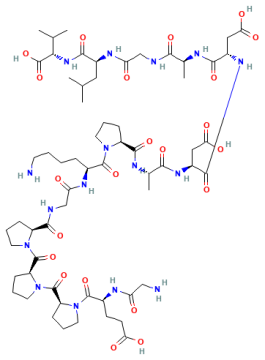
Compound data
Identifiers
- IUPAC name
- (4S)-4-[(2-aminoacetyl)amino]-5-[(2S)-2-[(2S)-2-[(2S)-2-[[2-[[(2S)-6-amino-1-[(2S)-2-[[(2S)-1-[[(2S)-3-carboxy-1-[[(2S)-3-carboxy-1-[[(2S)-1-[[2-[[(2S)-1-[[(1S)-1-carboxy-2-methylpropyl]amino]-4-methyl-1-oxopentan-2-yl]amino]-2-oxoethyl]amino]-1-oxopropan-2-yl]amino]-1-oxopropan-2-yl]amino]-1-oxopropan-2-yl]amino]-1-oxopropan-2-yl]carbamoyl]pyrrolidin-1-yl]-1-oxohexan-2-yl]amino]-2-oxoethyl]carbamoyl]pyrrolidine-1-carbonyl]pyrrolidine-1-carbonyl]pyrrolidin-1-yl]-5-oxopentanoic acid
- Synonyms
- Body protection compound 157, PL 14736, Bepecin, Gly-Glu-Pro-Pro-Pro-Gly-Lys-Pro-Ala-Asp-Asp-Ala-Gly-Leu-Val
- InChIKey
- HEEWEZGQMLZMFE-RKGINYAYSA-N
- SMILES
- C[C@@H](C(=O)N[C@@H](CC(=O)O)C(=O)N[C@@H](CC(=O)O)C(=O)N[C@@H](C)C(=O)NCC(=O)N[C@@H](CC(C)C)C(=O)N[C@@H](C(C)C)C(=O)O)NC(=O)[C@@H]1CCCN1C(=O)[C@H](CCCCN)NC(=O)CNC(=O)[C@@H]2CCCN2C(=O)[C@@H]3CCCN3C(=O)[C@@H]4CCCN4C(=O)[C@H](CCC(=O)O)NC(=O)CN
- Sequence
- GEPPPGKPADDAGLV
Properties
- Formula
- C62H98N16O22
- Molecular weight
- 1419.5 g/mol
- Monoisotopic mass
- 1418.70415882 Da
- XLogP3
- -9
- Polar surface area
- 573 Ų
- H-bond donors / acceptors
- 16 / 24
- Rotatable bonds
- 39
- Heavy atoms
- 100
- Formal charge
- 0
Computed by PubChem from the structure. About these values
Classification
- Class
- Peptides
- Mechanisms studied
- Origin
- Synthetic 15-residue fragment of a protein reported in human gastric juice
- Status
- Research compound
- Last reviewed
This record summarises chemistry and published research. It gives no doses, protocols or sources, and it is not a recommendation to use this compound.
Overview
BPC-157 is a linear peptide of fifteen amino acids, described as a partial sequence of a “body protection compound” isolated from human gastric juice. It is unusually stable in gastric juice for a peptide, which its developers cite as the reason it is active when given orally to rodents.
Mechanism
Proposed mechanisms include increased expression of growth-hormone receptor and VEGF receptor 2, activation of FAK–paxillin signalling and nitric oxide pathways, and promotion of angiogenesis and fibroblast migration (Seiwerth et al., 2018). In cultured tendon fibroblasts it increased outgrowth, survival under oxidative stress and migration (Chang et al., 2011). No specific receptor has been identified.
Research history
Predrag Sikirić and colleagues at the University of Zagreb have studied the peptide since the early 1990s and authored most of the published papers. It was briefly developed as PL 14736 for inflammatory bowel disease, but no results from that programme have been published in full.
Preclinical literature
A review of the musculoskeletal literature found consistently positive results in rat models of tendon, ligament, muscle and bone injury, while noting that most studies came from a single group and that independent replication was limited (Gwyer et al., 2019). Studies also report protection in models of gastrointestinal lesions, vascular occlusion and toxicity from other drugs (Seiwerth et al., 2018).
Human research & status
There are no published randomised controlled trials. BPC-157 is not approved by any regulator, appears on the World Anti-Doping Agency list of non-approved substances, and products sold online have no assurance of identity or purity.
References
- Seiwerth S, Rucman R, Turkovic B, et al. BPC 157 and Standard Angiogenic Growth Factors. Gastrointestinal Tract Healing, Lessons from Tendon, Ligament, Muscle and Bone Healing. Curr Pharm Des. 2018;24(18):1972-1989. DOI PubMed
- Chang CH, Tsai WC, Lin MS, et al. The promoting effect of pentadecapeptide BPC 157 on tendon healing involves tendon outgrowth, cell survival, and cell migration. J Appl Physiol (1985). 2011;110(3):774-80. DOI PubMed
- Gwyer D, Wragg NM, Wilson SL. Gastric pentadecapeptide body protection compound BPC 157 and its role in accelerating musculoskeletal soft tissue healing. Cell Tissue Res. 2019;377(2):153-159. DOI PubMed