RCD-035 Amino acids, amines & metabolites
Taurine
An abundant sulfonic amino acid that is not used to build proteins. Blood levels fall with age, and supplementation extended median lifespan in mice in a 2023 study.
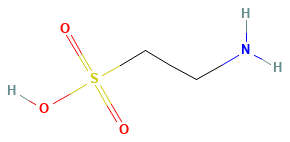
Compound data
Identifiers
- IUPAC name
- 2-aminoethanesulfonic acid
- Synonyms
- 2-Aminoethanesulfonic acid, Tauric acid
- InChIKey
- XOAAWQZATWQOTB-UHFFFAOYSA-N
- SMILES
- C(CS(=O)(=O)O)N
Properties
- Formula
- C2H7NO3S
- Molecular weight
- 125.15 g/mol
- Monoisotopic mass
- 125.01466426 Da
- XLogP3
- -4.1
- Polar surface area
- 88.8 Ų
- H-bond donors / acceptors
- 2 / 4
- Rotatable bonds
- 2
- Heavy atoms
- 7
- Formal charge
- 0
Computed by PubChem from the structure. About these values
Classification
- Mechanisms studied
- Origin
- Made from cysteine in the body; abundant in meat, fish and shellfish
- First described
- 1827
- Status
- Food or supplement
- Last reviewed
This record summarises chemistry and published research. It gives no doses, protocols or sources, and it is not a recommendation to use this compound.
Overview
Taurine is an amino acid with a sulfonic acid group in place of the usual carboxylic acid. It is among the most abundant free amino acids in heart, muscle, retina and brain, and it conjugates bile acids in the liver. Cats cannot make enough and need it in their diet.
Mechanism
Taurine regulates cell volume and calcium handling, conjugates bile acids, and is incorporated into mitochondrial transfer RNAs, where it is needed for accurate translation of mitochondrially encoded proteins. In the 2023 study, supplementation reduced markers of senescence, DNA damage, mitochondrial dysfunction and inflammation in aged mice (Singh et al., 2023).
Research history
Friedrich Tiedemann and Leopold Gmelin isolated taurine from ox bile in 1827, and the name comes from the Latin taurus. It is added to infant formula and energy drinks.
Preclinical literature
Singh and colleagues reported that blood taurine falls with age in mice, monkeys and people; that supplementation from middle age extended median lifespan in mice; and that it improved several health measures in middle-aged rhesus monkeys (Singh et al., 2023). The lifespan result has not yet been replicated in the ITP.
Human research & status
In the same paper, lower blood taurine was associated with obesity, diabetes and inflammation in a human cohort, and exercise raised taurine levels (Singh et al., 2023). Later human studies have reported that taurine does not decline consistently with age in all populations. There are no aging trials.