RCD-030 Quinones & redox cofactors
Mitoquinone
A mitochondria-targeted antioxidant: a ubiquinone head linked to a lipophilic cation that the mitochondrial membrane potential pulls inside. It improved vascular function in older adults.
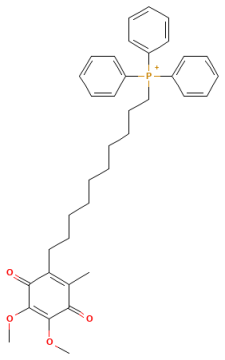
Compound data
Identifiers
- IUPAC name
- 10-(4,5-dimethoxy-2-methyl-3,6-dioxocyclohexa-1,4-dien-1-yl)decyl-triphenylphosphanium
- Synonyms
- MitoQ, MitoQ10, Mitoquinone mesylate
- InChIKey
- OIIMUKXVVLRCAF-UHFFFAOYSA-N
- SMILES
- CC1=C(C(=O)C(=C(C1=O)OC)OC)CCCCCCCCCC[P+](C2=CC=CC=C2)(C3=CC=CC=C3)C4=CC=CC=C4
Properties
- Formula
- C37H44O4P+
- Molecular weight
- 583.7 g/mol
- Monoisotopic mass
- 583.29772188 Da
- XLogP3
- 9.4
- Polar surface area
- 52.6 Ų
- H-bond donors / acceptors
- 0 / 4
- Rotatable bonds
- 16
- Heavy atoms
- 42
- Formal charge
- 1
Computed by PubChem from the structure. About these values
Classification
- Mechanisms studied
- Origin
- Synthetic: ubiquinone linked to a triphenylphosphonium cation by a ten-carbon chain
- First described
- 2001
- Status
- Food or supplement
- Last reviewed
This record summarises chemistry and published research. It gives no doses, protocols or sources, and it is not a recommendation to use this compound.
Overview
MitoQ was designed to solve a delivery problem: ordinary antioxidants spread through the cell, while much reactive oxygen production happens in the mitochondrial matrix. Attaching a triphenylphosphonium (TPP) cation gives the molecule a delocalised positive charge and makes it lipophilic, so it crosses membranes and accumulates several hundred-fold inside mitochondria in response to the membrane potential. PubChem lists the cation; the product is the mesylate salt.
Mechanism
Inside mitochondria, the ubiquinone head is reduced to the ubiquinol form by complex II and acts as a chain-breaking antioxidant against lipid peroxidation, then is recycled. Kelso and colleagues showed that MitoQ protected cells against oxidative damage and apoptosis far more effectively than untargeted analogues (Kelso et al., 2001).
Research history
Michael Murphy and Robin Smith developed MitoQ in the late 1990s. It became the prototype for a family of TPP-targeted compounds and probes.
Preclinical literature
Animal studies report protection in models of ischaemia–reperfusion, cardiovascular disease, fatty liver and sepsis. Lifespan studies in flies and mice have been mostly negative.
Human research & status
In a randomised trial in healthy older adults, six weeks of MitoQ improved endothelial function and lowered aortic stiffness and circulating oxidised LDL (Rossman et al., 2018). A one-year trial in early Parkinson’s disease found no effect on disease progression (Snow et al., 2010).
References
- Kelso GF, Porteous CM, Coulter CV, et al. Selective targeting of a redox-active ubiquinone to mitochondria within cells: antioxidant and antiapoptotic properties. J Biol Chem. 2001;276(7):4588-96. DOI PubMed
- Rossman MJ, Santos-Parker JR, Steward CAC, et al. Chronic Supplementation With a Mitochondrial Antioxidant (MitoQ) Improves Vascular Function in Healthy Older Adults. Hypertension. 2018;71(6):1056-1063. DOI PubMed
- Snow BJ, Rolfe FL, Lockhart MM, et al. A double-blind, placebo-controlled study to assess the mitochondria-targeted antioxidant MitoQ as a disease-modifying therapy in Parkinson's disease. Mov Disord. 2010;25(11):1670-4. DOI PubMed