RCD-028 Carbohydrates & sugar analogues
Glucosamine
An amino sugar used for joint health. It extended lifespan in worms and old mice, and users had lower mortality in UK Biobank, an association that may reflect healthier users.
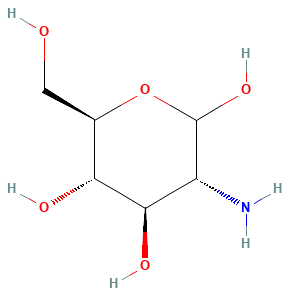
Compound data
Identifiers
- IUPAC name
- (3R,4R,5S,6R)-3-amino-6-(hydroxymethyl)oxane-2,4,5-triol
- Synonyms
- D-Glucosamine, 2-Amino-2-deoxy-D-glucose, Chitosamine
- InChIKey
- MSWZFWKMSRAUBD-IVMDWMLBSA-N
- SMILES
- C([C@@H]1[C@H]([C@@H]([C@H](C(O1)O)N)O)O)O
Properties
- Formula
- C6H13NO5
- Molecular weight
- 179.17 g/mol
- Monoisotopic mass
- 179.07937252 Da
- XLogP3
- -2.8
- Polar surface area
- 116 Ų
- H-bond donors / acceptors
- 5 / 6
- Rotatable bonds
- 1
- Heavy atoms
- 12
- Formal charge
- 0
Computed by PubChem from the structure. About these values
Classification
- Mechanisms studied
- Origin
- Amino sugar made in the body; supplements are made from shellfish chitin or by fermentation
- Status
- Food or supplement
- Last reviewed
This record summarises chemistry and published research. It gives no doses, protocols or sources, and it is not a recommendation to use this compound.
Overview
Glucosamine is glucose with an amino group in place of the 2-hydroxyl. The body makes it as glucosamine-6-phosphate in the hexosamine biosynthesis pathway, which supplies the building blocks for glycosaminoglycans in cartilage and for protein glycosylation.
Mechanism
In C. elegans and mice, glucosamine impaired glycolysis, increased mitochondrial respiration and activated AMPK, a mitohormetic mechanism resembling that of 2-deoxyglucose (Weimer et al., 2014). Its proposed effect on joints is to supply substrate for cartilage matrix and to reduce inflammatory signalling in chondrocytes.
Research history
Glucosamine was first prepared from chitin in the nineteenth century. It has been sold for joint health since the 1990s.
Preclinical literature
Glucosamine extended the lifespan of nematodes and, when given to old C57BL/6 mice, extended their remaining lifespan and lowered blood glucose (Weimer et al., 2014). This was a single-laboratory result and has not been repeated in the ITP.
Human research & status
In about 500,000 UK Biobank participants, regular glucosamine use was associated with lower all-cause and cardiovascular mortality (Li et al., 2020). Users differed from non-users in many ways, so the association may not be causal. For its original use, a large NIH-funded trial found that glucosamine did not significantly reduce knee osteoarthritis pain overall compared with placebo (Clegg et al., 2006).
References
- Weimer S, Priebs J, Kuhlow D, et al. D-Glucosamine supplementation extends life span of nematodes and of ageing mice. Nat Commun. 2014;5:3563. DOI PubMed
- Li ZH, Gao X, Chung VC, et al. Associations of regular glucosamine use with all-cause and cause-specific mortality: a large prospective cohort study. Ann Rheum Dis. 2020;79(6):829-836. DOI PubMed
- Clegg DO, Reda DJ, Harris CL, et al. Glucosamine, chondroitin sulfate, and the two in combination for painful knee osteoarthritis. N Engl J Med. 2006;354(8):795-808. DOI PubMed