RCD-024 Nucleotides & NAD+ precursors
AICAR
A cell-permeable nucleoside that cells phosphorylate to ZMP, an AMP mimic that activates AMPK. It is a standard laboratory AMPK activator and was described in mice as an "exercise mimetic".
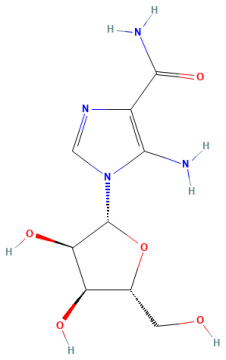
Compound data
Identifiers
- IUPAC name
- 5-amino-1-[(2R,3R,4S,5R)-3,4-dihydroxy-5-(hydroxymethyl)oxolan-2-yl]imidazole-4-carboxamide
- Synonyms
- Acadesine, 5-aminoimidazole-4-carboxamide ribonucleoside, AICA riboside
- InChIKey
- RTRQQBHATOEIAF-UUOKFMHZSA-N
- SMILES
- C1=NC(=C(N1[C@H]2[C@@H]([C@@H]([C@H](O2)CO)O)O)N)C(=O)N
Properties
- Formula
- C9H14N4O5
- Molecular weight
- 258.23 g/mol
- Monoisotopic mass
- 258.09641956 Da
- XLogP3
- -2.2
- Polar surface area
- 157 Ų
- H-bond donors / acceptors
- 5 / 7
- Rotatable bonds
- 3
- Heavy atoms
- 18
- Formal charge
- 0
Computed by PubChem from the structure. About these values
Classification
- Mechanisms studied
- Origin
- Synthetic nucleoside; its monophosphate (ZMP) is a natural purine-synthesis intermediate
- Status
- Research compound
- Last reviewed
This record summarises chemistry and published research. It gives no doses, protocols or sources, and it is not a recommendation to use this compound.
Overview
AICAR is the riboside of 5-aminoimidazole-4-carboxamide. Inside cells, adenosine kinase converts it to ZMP, which resembles AMP closely enough to bind the regulatory γ subunit of AMPK. It has been the most widely used pharmacological AMPK activator for three decades.
Mechanism
Corton and colleagues showed that AICAR activated AMPK in intact cells and inhibited the AMPK targets acetyl-CoA carboxylase and HMG-CoA reductase, establishing it as a research tool (Corton et al., 1995). ZMP also affects other AMP-sensitive enzymes, such as fructose-1,6-bisphosphatase, so not all of AICAR’s effects run through AMPK.
Research history
As acadesine, AICAR was tested in the 1990s and 2000s to protect the heart during coronary bypass surgery; a large trial was stopped for futility. Its 2008 description as an exercise mimetic led to its inclusion on the World Anti-Doping Agency prohibited list.
Preclinical literature
Four weeks of AICAR in sedentary mice increased running endurance and induced oxidative muscle gene expression; combining it with a PPARδ agonist enhanced the effect (Narkar et al., 2008). AICAR is also used in studies of AMPK in cancer, inflammation and metabolism. Its short half-life and off-target effects make it a tool rather than a drug candidate.
Human research & status
Human data come mainly from the acadesine surgical trials and small metabolic studies. It is not approved for any use.
References
- Corton JM, Gillespie JG, Hawley SA, et al. 5-aminoimidazole-4-carboxamide ribonucleoside. A specific method for activating AMP-activated protein kinase in intact cells?. Eur J Biochem. 1995;229(2):558-65. DOI PubMed
- Narkar VA, Downes M, Yu RT, et al. AMPK and PPARdelta agonists are exercise mimetics. Cell. 2008;134(3):405-15. DOI PubMed