RCD-023 Nucleotides & NAD+ precursors
NAD+
The central redox cofactor of metabolism and the substrate of sirtuins, PARPs and CD38. Its decline with age in many tissues is the rationale for NAD+ precursor research.
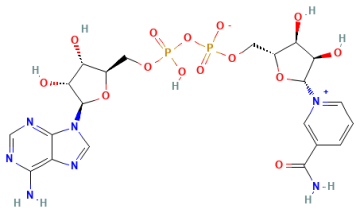
Compound data
Identifiers
- IUPAC name
- [[(2R,3S,4R,5R)-5-(6-aminopurin-9-yl)-3,4-dihydroxyoxolan-2-yl]methoxy-hydroxyphosphoryl] [(2R,3S,4R,5R)-5-(3-carbamoylpyridin-1-ium-1-yl)-3,4-dihydroxyoxolan-2-yl]methyl phosphate
- Synonyms
- Nicotinamide adenine dinucleotide, Nadide, β-NAD+, Coenzyme I, DPN
- InChIKey
- BAWFJGJZGIEFAR-NNYOXOHSSA-N
- SMILES
- C1=CC(=C[N+](=C1)[C@H]2[C@@H]([C@@H]([C@H](O2)COP(=O)([O-])OP(=O)(O)OC[C@@H]3[C@H]([C@H]([C@@H](O3)N4C=NC5=C(N=CN=C54)N)O)O)O)O)C(=O)N
Properties
- Formula
- C21H27N7O14P2
- Molecular weight
- 663.4 g/mol
- Monoisotopic mass
- 663.10912256 Da
- XLogP3
- -6
- Polar surface area
- 321 Ų
- H-bond donors / acceptors
- 7 / 18
- Rotatable bonds
- 11
- Heavy atoms
- 44
- Formal charge
- 0
Computed by PubChem from the structure. About these values
Classification
- Mechanisms studied
- Origin
- Made in every living cell from tryptophan, nicotinic acid, nicotinamide, NR or NMN
- First described
- 1906
- Status
- Research compound
- Last reviewed
This record summarises chemistry and published research. It gives no doses, protocols or sources, and it is not a recommendation to use this compound.
Overview
NAD+ is a dinucleotide: an adenosine nucleotide joined through a pyrophosphate to a nicotinamide nucleotide. It cycles between oxidised (NAD+) and reduced (NADH) forms in glycolysis, the Krebs cycle and the electron-transport chain, and it is consumed, not recycled, by signalling enzymes that cleave it.
Mechanism
Three families of enzymes consume NAD+: sirtuins, which remove acetyl and other acyl groups from proteins; PARPs, which build poly-ADP-ribose chains at DNA damage; and the NADases CD38 and SARM1. As NAD+ levels fall, these enzymes compete, and sirtuin-dependent processes such as mitochondrial maintenance may lose out (Verdin, 2015). Rodent tissues show lower NAD+ with age, and the rise of CD38 on inflammatory cells is one proposed cause.
Research history
Arthur Harden and William Young described a heat-stable “cozymase” required for yeast fermentation in 1906. Hans von Euler-Chelpin characterised it as a nucleotide, and the two shared the 1929 Nobel Prize in Chemistry. Otto Warburg showed its role in hydrogen transfer in the 1930s.
Preclinical literature
Raising NAD+ with precursors improves mitochondrial, metabolic, muscle and neuronal function in aged and disease-model rodents (Rajman et al., 2018). Extracellular NAD+ is largely broken down to NMN, NR and nicotinamide before cells take it up, so giving NAD+ itself acts mostly through these products.
Human research & status
Controlled human studies have used precursors rather than NAD+ itself; see the records for nicotinamide riboside, NMN and nicotinamide. Infusions of NAD+ are offered commercially without published efficacy data from controlled trials.