RCD-022 Nucleotides & NAD+ precursors
Nicotinamide
The amide form of vitamin B3 and the main NAD+ salvage precursor. A phase 3 trial found fewer new non-melanoma skin cancers in high-risk patients, and it improved healthspan but not lifespan in mice.
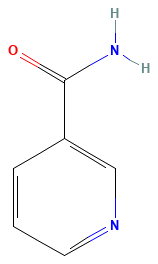
Compound data
Identifiers
- IUPAC name
- pyridine-3-carboxamide
- Synonyms
- Niacinamide, Nicotinic acid amide, Vitamin B3 (amide form)
- InChIKey
- DFPAKSUCGFBDDF-UHFFFAOYSA-N
- SMILES
- C1=CC(=CN=C1)C(=O)N
Properties
- Formula
- C6H6N2O
- Molecular weight
- 122.12 g/mol
- Monoisotopic mass
- 122.048012819 Da
- XLogP3
- -0.4
- Polar surface area
- 56 Ų
- H-bond donors / acceptors
- 1 / 2
- Rotatable bonds
- 1
- Heavy atoms
- 9
- Formal charge
- 0
Computed by PubChem from the structure. About these values
Classification
- Mechanisms studied
- Origin
- Vitamin B3 amide in meat, fish, legumes and fortified foods; made from NAD+ breakdown in the body
- Status
- Food or supplement
- Last reviewed
This record summarises chemistry and published research. It gives no doses, protocols or sources, and it is not a recommendation to use this compound.
Overview
Nicotinamide is both a dietary vitamin and the by-product of every NAD+-consuming reaction. Sirtuins, PARPs and CD38 release it when they break down NAD+, and the salvage pathway recycles it back to NAD+ through NMN.
Mechanism
As an NAD+ precursor, nicotinamide supports energy metabolism and DNA repair. In vitro it also acts as a feedback inhibitor of sirtuins, which complicates its use as a sirtuin-supporting supplement. In the skin it supports DNA repair after ultraviolet exposure and limits ultraviolet-induced immunosuppression (Chen et al., 2015). Unlike nicotinic acid, it does not cause flushing.
Research history
Nicotinamide was identified as the anti-pellagra factor in the 1930s. Its role in NAD+ biology has been studied since, and it is now one of three NAD+ precursors, with NR and NMN, examined in aging research.
Preclinical literature
In mice, long-term nicotinamide improved some aspects of healthspan, including glucose homeostasis and reduced fatty liver and inflammation in mice on a high-fat diet, but it did not extend lifespan on either standard or high-fat diets (Mitchell et al., 2018).
Human research & status
In the ONTRAC phase 3 trial in people with at least two non-melanoma skin cancers in the previous five years, twelve months of nicotinamide reduced new non-melanoma skin cancers by 23 percent compared with placebo (Chen et al., 2015). The effect did not persist after stopping. Very high intakes can cause liver toxicity.
References
- Chen AC, Martin AJ, Choy B, et al. A Phase 3 Randomized Trial of Nicotinamide for Skin-Cancer Chemoprevention. N Engl J Med. 2015;373(17):1618-26. DOI PubMed
- Mitchell SJ, Bernier M, Aon MA, et al. Nicotinamide Improves Aspects of Healthspan, but Not Lifespan, in Mice. Cell Metab. 2018;27(3):667-676.e4. DOI PubMed
- Rajman L, Chwalek K, Sinclair DA. Therapeutic Potential of NAD-Boosting Molecules: The In Vivo Evidence. Cell Metab. 2018;27(3):529-547. DOI PubMed