RCD-018 Alkaloids
Berberine
A yellow quaternary isoquinoline alkaloid that activates AMPK by inhibiting mitochondrial complex I, the same broad mechanism proposed for metformin.
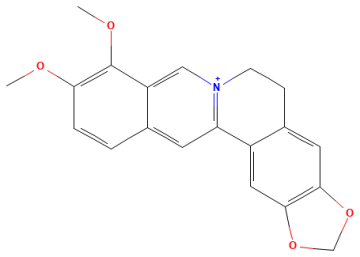
Compound data
Identifiers
- IUPAC name
- 16,17-dimethoxy-5,7-dioxa-13-azoniapentacyclo[11.8.0.02,10.04,8.015,20]henicosa-1(13),2,4(8),9,14,16,18,20-octaene
- Synonyms
- Umbellatine, Berberine chloride (salt form), Natural Yellow 18
- InChIKey
- YBHILYKTIRIUTE-UHFFFAOYSA-N
- SMILES
- COC1=C(C2=C[N+]3=C(C=C2C=C1)C4=CC5=C(C=C4CC3)OCO5)OC
Properties
- Formula
- C20H18NO4+
- Molecular weight
- 336.4 g/mol
- Monoisotopic mass
- 336.12358306 Da
- XLogP3
- 3.6
- Polar surface area
- 40.8 Ų
- H-bond donors / acceptors
- 0 / 4
- Rotatable bonds
- 2
- Heavy atoms
- 25
- Formal charge
- 1
Computed by PubChem from the structure. About these values
Classification
- Class
- Alkaloids
- Mechanisms studied
- Origin
- Isoquinoline alkaloid from barberry (Berberis), goldenseal and Coptis chinensis
- Status
- Food or supplement
- Last reviewed
This record summarises chemistry and published research. It gives no doses, protocols or sources, and it is not a recommendation to use this compound.
Overview
Berberine is a permanently charged protoberberine alkaloid, which is why PubChem lists its parent record as a cation and most products contain the chloride or sulfate salt. It is bright yellow, fluoresces under ultraviolet light, and has been used as a dye and in Chinese and Ayurvedic medicine.
Mechanism
Berberine activates AMPK in fat and muscle cells and improved glucose tolerance and body weight in obese rodents (Lee et al., 2006). Turner and colleagues showed that it inhibits mitochondrial respiratory complex I, which lowers ATP and explains AMPK activation, and that its reduced derivative dihydroberberine is better absorbed (Turner et al., 2008). It also inhibits PCSK9 transcription and changes the gut microbiome, which may contribute to its lipid effects.
Research history
Berberine has been used in China for gastrointestinal infections for many decades. Its metabolic effects attracted attention from the early 2000s, and its similarity to metformin, a weak complex I inhibitor that activates AMPK, made it a frequent comparison.
Preclinical literature
Rodent studies report improved insulin sensitivity, lower lipids and reduced fatty liver (Lee et al., 2006; Turner et al., 2008). Worm and fly studies report lifespan extension in some conditions. No multi-site mouse lifespan study has been published.
Human research & status
A small randomised study in adults with type 2 diabetes reported glucose-lowering effects similar to metformin over three months (Yin et al., 2008). Many later trials, mostly from China, have been pooled in meta-analyses with similar findings but high risk of bias. Berberine has low oral bioavailability, causes gastrointestinal side effects, and inhibits drug-metabolising enzymes such as CYP3A4 and CYP2D6, so interactions with prescription medicines are possible.
References
- Lee YS, Kim WS, Kim KH, et al. Berberine, a natural plant product, activates AMP-activated protein kinase with beneficial metabolic effects in diabetic and insulin-resistant states. Diabetes. 2006;55(8):2256-64. DOI PubMed
- Turner N, Li JY, Gosby A, et al. Berberine and its more biologically available derivative, dihydroberberine, inhibit mitochondrial respiratory complex I: a mechanism for the action of berberine to activate AMP-activated protein kinase and improve insulin action. Diabetes. 2008;57(5):1414-8. DOI PubMed
- Yin J, Xing H, Ye J. Efficacy of berberine in patients with type 2 diabetes mellitus. Metabolism. 2008;57(5):712-7. DOI PubMed