RCD-017 Polyphenols & natural pigments
Astaxanthin
A red keto-carotenoid from microalgae and seafood. In 2024 it became one of the few compounds to extend lifespan in the ITP, in male mice only.
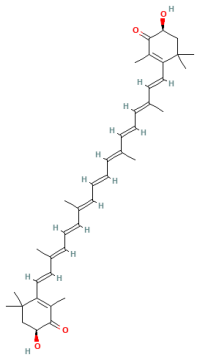
Compound data
Identifiers
- IUPAC name
- (6S)-6-hydroxy-3-[(1E,3E,5E,7E,9E,11E,13E,15E,17E)-18-[(4S)-4-hydroxy-2,6,6-trimethyl-3-oxocyclohexen-1-yl]-3,7,12,16-tetramethyloctadeca-1,3,5,7,9,11,13,15,17-nonaenyl]-2,4,4-trimethylcyclohex-2-en-1-one
- Synonyms
- 3,3′-dihydroxy-β,β-carotene-4,4′-dione, E161j
- InChIKey
- MQZIGYBFDRPAKN-UWFIBFSHSA-N
- SMILES
- CC1=C(C(C[C@@H](C1=O)O)(C)C)/C=C/C(=C/C=C/C(=C/C=C/C=C(/C=C/C=C(/C=C/C2=C(C(=O)[C@H](CC2(C)C)O)C)C)C)/C)/C
Properties
- Formula
- C40H52O4
- Molecular weight
- 596.8 g/mol
- Monoisotopic mass
- 596.38656014 Da
- XLogP3
- 10.3
- Polar surface area
- 74.6 Ų
- H-bond donors / acceptors
- 2 / 4
- Rotatable bonds
- 10
- Heavy atoms
- 44
- Formal charge
- 0
Computed by PubChem from the structure. About these values
Classification
- Mechanisms studied
- Origin
- Keto-carotenoid made by the microalga Haematococcus pluvialis; gives salmon and shrimp their colour
- First described
- 1938
- Status
- Food or supplement
- Last reviewed
This record summarises chemistry and published research. It gives no doses, protocols or sources, and it is not a recommendation to use this compound.
Overview
Astaxanthin is a xanthophyll carotenoid with a 40-carbon polyene chain capped at each end by a ring bearing a hydroxyl and a ketone. That structure lets it span cell membranes, with its polar ends at each surface. Animals cannot make it; salmon, krill and flamingos get it through the food chain from microalgae.
Mechanism
Astaxanthin quenches singlet oxygen and scavenges radicals inside lipid membranes without becoming a pro-oxidant, which distinguishes it from some other carotenoids. It also reduces inflammatory signalling and supports mitochondrial function in cell and animal models (Ambati et al., 2014).
Research history
Astaxanthin was identified in lobster in the 1930s. It became commercially important as a feed additive for farmed salmon and later as a dietary supplement produced from Haematococcus algae.
Preclinical literature
The ITP reported in 2024 that astaxanthin extended median lifespan in male genetically heterogeneous mice, with no significant effect in females; in the same report, fisetin and several other compounds did not extend lifespan (Harrison et al., 2024). Earlier studies in worms and flies also reported lifespan effects.
Human research & status
Small human trials have studied skin, eye fatigue, exercise and lipid markers, with modest results and mostly short durations (Ambati et al., 2014). No human study has addressed aging outcomes.
References
- Ambati RR, Phang SM, Ravi S, et al. Astaxanthin: sources, extraction, stability, biological activities and its commercial applications--a review. Mar Drugs. 2014;12(1):128-52. DOI PubMed
- Harrison DE, Strong R, Reifsnyder P, et al. Astaxanthin and meclizine extend lifespan in UM-HET3 male mice; fisetin, SG1002 (hydrogen sulfide donor), dimethyl fumarate, mycophenolic acid, and 4-phenylbutyrate do not significantly affect lifespan in either sex at the doses and schedules used. Geroscience. 2024;46(1):795-816. DOI PubMed