RCD-012 Polyphenols & natural pigments
Pterostilbene
A dimethylated relative of resveratrol with two methoxy groups, which make it more lipophilic and much more bioavailable in rodents.
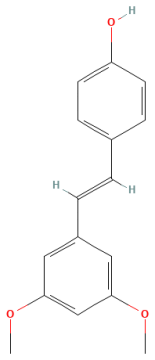
Compound data
Identifiers
- IUPAC name
- 4-[(E)-2-(3,5-dimethoxyphenyl)ethenyl]phenol
- Synonyms
- trans-3,5-dimethoxy-4′-hydroxystilbene, Resveratrol dimethyl ether
- InChIKey
- VLEUZFDZJKSGMX-ONEGZZNKSA-N
- SMILES
- COC1=CC(=CC(=C1)/C=C/C2=CC=C(C=C2)O)OC
Properties
- Formula
- C16H16O3
- Molecular weight
- 256.30 g/mol
- Monoisotopic mass
- 256.109944368 Da
- XLogP3
- 3.8
- Polar surface area
- 38.7 Ų
- H-bond donors / acceptors
- 1 / 3
- Rotatable bonds
- 4
- Heavy atoms
- 19
- Formal charge
- 0
Computed by PubChem from the structure. About these values
Classification
- Mechanisms studied
- Origin
- Stilbene in blueberries, grapes and the heartwood of Pterocarpus species
- First described
- 1940
- Status
- Food or supplement
- Last reviewed
This record summarises chemistry and published research. It gives no doses, protocols or sources, and it is not a recommendation to use this compound.
Overview
Pterostilbene has the same stilbene skeleton as resveratrol but with methoxy groups in place of two of its three hydroxyls. That change slows conjugation and increases lipophilicity, which in rat studies gives several-fold higher oral bioavailability than resveratrol.
Mechanism
Its reported activities overlap with those of resveratrol: radical scavenging, NRF2 activation, anti-inflammatory signalling and effects on lipid and glucose metabolism (McCormack and McFadden, 2013). Like resveratrol it has many molecular targets, and none is established as the cause of its effects in animals.
Research history
Pterostilbene was first isolated from red sandalwood (Pterocarpus santalinus) in 1940. Interest in it grew from comparisons with resveratrol in the 2000s, and it is sold alone and combined with nicotinamide riboside.
Preclinical literature
Cell and rodent studies report antioxidant, anti-inflammatory, anti-cancer and cognitive effects, mostly from single laboratories and at exposures above those reached by diet (McCormack and McFadden, 2013). No multi-site lifespan study has been published.
Human research & status
A placebo-controlled trial in adults with high cholesterol found pterostilbene well tolerated, with no adverse effects on liver, kidney or glucose markers (Riche et al., 2013). Data on longer-term use and on aging-related outcomes are lacking.