RCD-008 Synthetic small molecules
Chloroquine
A 4-aminoquinoline antimalarial that raises lysosomal pH and blocks the fusion of autophagosomes with lysosomes. Researchers use it to measure autophagy rather than to boost it.
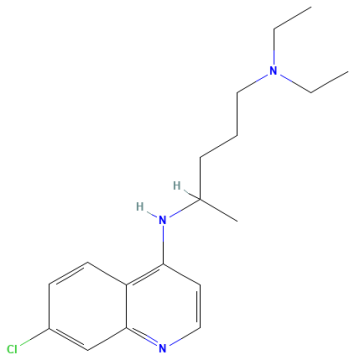
Compound data
Identifiers
- IUPAC name
- 4-N-(7-chloroquinolin-4-yl)-1-N,1-N-diethylpentane-1,4-diamine
- Synonyms
- Resochin, Aralen, Chlorochin
- InChIKey
- WHTVZRBIWZFKQO-UHFFFAOYSA-N
- SMILES
- CCN(CC)CCCC(C)NC1=C2C=CC(=CC2=NC=C1)Cl
Properties
- Formula
- C18H26ClN3
- Molecular weight
- 319.9 g/mol
- Monoisotopic mass
- 319.1815255 Da
- XLogP3
- 4.6
- Polar surface area
- 28.2 Ų
- H-bond donors / acceptors
- 1 / 3
- Rotatable bonds
- 8
- Heavy atoms
- 22
- Formal charge
- 0
Computed by PubChem from the structure. About these values
Classification
- Mechanisms studied
- Origin
- Synthetic 4-aminoquinoline
- First described
- 1934
- Status
- Approved medicine
- Last reviewed
This record summarises chemistry and published research. It gives no doses, protocols or sources, and it is not a recommendation to use this compound.
Overview
Chloroquine is included in this database for a different reason from most entries: it is one of the standard reagents used to measure autophagy. Many claims that a compound “induces autophagy” rest on experiments in which chloroquine or bafilomycin A1 is used to block the final, lysosomal step of the pathway.
Mechanism
Chloroquine is a weak base that diffuses into acidic compartments and becomes trapped when protonated. Its accumulation raises lysosomal pH, and its main effect on autophagy is to impair the fusion of autophagosomes with lysosomes, with additional disorganisation of the Golgi and endosomal systems (Mauthe et al., 2018). When autophagic flux is blocked, autophagosome markers such as LC3-II accumulate; comparing LC3-II with and without chloroquine shows whether a treatment increases flux or only blocks clearance (Klionsky et al., 2021).
Research history
Hans Andersag synthesised chloroquine at Bayer in 1934. It became a mainstay antimalarial after the Second World War, until resistance spread. Its derivative hydroxychloroquine is used for lupus and rheumatoid arthritis.
Preclinical literature
In aging studies, chloroquine is used to test whether a lifespan or healthspan effect depends on autophagy. Because it also affects other lysosomal and endosomal processes, guidelines recommend combining it with genetic approaches before drawing conclusions (Klionsky et al., 2021).
Human research & status
Chloroquine is an approved antimalarial with known risks, including retinal toxicity with long-term use, QT prolongation and a narrow margin between therapeutic and toxic exposure. It is not studied as an aging intervention.
References
- Mauthe M, Orhon I, Rocchi C, et al. Chloroquine inhibits autophagic flux by decreasing autophagosome-lysosome fusion. Autophagy. 2018;14(8):1435-1455. DOI PubMed
- Klionsky DJ, Abdel-Aziz AK, Abdelfatah S, et al. Guidelines for the use and interpretation of assays for monitoring autophagy (4th edition)(1). Autophagy. 2021;17(1):1-382. DOI PubMed