RCD-007 Synthetic small molecules
SRT1720
A synthetic SIRT1-activating compound reported to be far more potent than resveratrol. Its mechanism was disputed, and it extended lifespan modestly in mice on standard and high-fat diets.
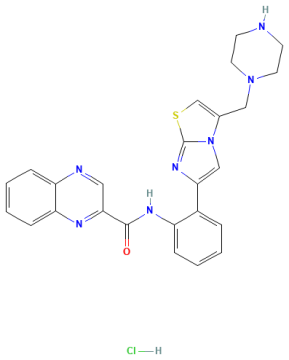
Compound data
Identifiers
- IUPAC name
- N-[2-[3-(piperazin-1-ylmethyl)imidazo[2,1-b][1,3]thiazol-6-yl]phenyl]quinoxaline-2-carboxamide;hydrochloride
- Synonyms
- SRT-1720
- InChIKey
- DTGRRMPPXCRRIM-UHFFFAOYSA-N
- SMILES
- C1CN(CCN1)CC2=CSC3=NC(=CN23)C4=CC=CC=C4NC(=O)C5=NC6=CC=CC=C6N=C5.Cl
Properties
- Formula
- C25H24ClN7OS
- Molecular weight
- 506.0 g/mol
- Monoisotopic mass
- 505.1451573 Da
- Polar surface area
- 116 Ų
- H-bond donors / acceptors
- 3 / 7
- Rotatable bonds
- 5
- Heavy atoms
- 35
- Formal charge
- 0
Computed by PubChem from the structure. About these values
Classification
- Mechanisms studied
- Origin
- Synthetic imidazothiazole developed by Sirtris Pharmaceuticals
- First described
- 2007
- Status
- Research compound
- Last reviewed
This record summarises chemistry and published research. It gives no doses, protocols or sources, and it is not a recommendation to use this compound.
Overview
SRT1720 was one of several sirtuin-activating compounds (STACs) designed by Sirtris Pharmaceuticals to be more potent and selective than resveratrol. It is now used only as a laboratory tool, but its history is central to the debate about whether sirtuins can be activated directly by small molecules.
Mechanism
SIRT1 is an NAD+-dependent deacetylase that regulates metabolism and stress responses. Milne and colleagues reported that SRT1720 activated SIRT1 several hundred times more strongly than resveratrol in an in-vitro assay (Milne et al., 2007). Researchers at Pfizer then showed that activation in that assay depended on a fluorescent tag attached to the peptide substrate and was not seen with native substrates, and concluded that the compounds were not direct activators (Pacholec et al., 2010). Later work proposed that activation depends on particular hydrophobic residues in the substrate, so the debate is about which substrates, not whether binding occurs.
Research history
The 2007 report that SRT1720 improved insulin sensitivity in obese and diabetic rodents preceded the acquisition of Sirtris by GlaxoSmithKline in 2008. The clinical programme moved to other compounds and was later closed.
Preclinical literature
SRT1720 extended mean lifespan and improved liver and metabolic health in mice fed a high-fat diet (Minor et al., 2011), and extended mean lifespan by a smaller margin in mice fed a standard diet, with lower inflammatory gene expression (Mitchell et al., 2014). Both studies were in a single mouse strain and were not part of a multi-site programme.
Human research & status
SRT1720 has not been tested in people. Related compounds (SRT2104) reached early clinical trials with modest results.
References
- Milne JC, Lambert PD, Schenk S, et al. Small molecule activators of SIRT1 as therapeutics for the treatment of type 2 diabetes. Nature. 2007;450(7170):712-6. DOI PubMed
- Pacholec M, Bleasdale JE, Chrunyk B, et al. SRT1720, SRT2183, SRT1460, and resveratrol are not direct activators of SIRT1. J Biol Chem. 2010;285(11):8340-51. DOI PubMed
- Minor RK, Baur JA, Gomes AP, et al. SRT1720 improves survival and healthspan of obese mice. Sci Rep. 2011;1:70. DOI PubMed
- Mitchell SJ, Martin-Montalvo A, Mercken EM, et al. The SIRT1 activator SRT1720 extends lifespan and improves health of mice fed a standard diet. Cell Rep. 2014;6(5):836-43. DOI PubMed
- Howitz KT, Bitterman KJ, Cohen HY, et al. Small molecule activators of sirtuins extend Saccharomyces cerevisiae lifespan. Nature. 2003;425(6954):191-6. DOI PubMed