RCD-006 Synthetic small molecules
Navitoclax
A BH3-mimetic inhibitor of BCL-2, BCL-xL and BCL-w. It clears senescent cells in mice, but loss of platelets, which depend on BCL-xL, limits its use.
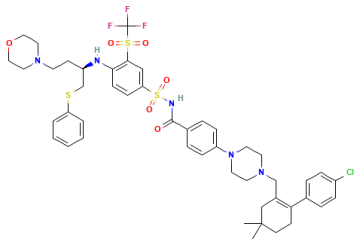
Compound data
Identifiers
- IUPAC name
- 4-[4-[[2-(4-chlorophenyl)-5,5-dimethylcyclohexen-1-yl]methyl]piperazin-1-yl]-N-[4-[[(2R)-4-morpholin-4-yl-1-phenylsulfanylbutan-2-yl]amino]-3-(trifluoromethylsulfonyl)phenyl]sulfonylbenzamide
- Synonyms
- ABT-263
- InChIKey
- JLYAXFNOILIKPP-KXQOOQHDSA-N
- SMILES
- CC1(CCC(=C(C1)CN2CCN(CC2)C3=CC=C(C=C3)C(=O)NS(=O)(=O)C4=CC(=C(C=C4)N[C@H](CCN5CCOCC5)CSC6=CC=CC=C6)S(=O)(=O)C(F)(F)F)C7=CC=C(C=C7)Cl)C
Properties
- Formula
- C47H55ClF3N5O6S3
- Molecular weight
- 974.6 g/mol
- Monoisotopic mass
- 973.2955102 Da
- XLogP3
- 9.6
- Polar surface area
- 170 Ų
- H-bond donors / acceptors
- 2 / 14
- Rotatable bonds
- 16
- Heavy atoms
- 65
- Formal charge
- 0
Computed by PubChem from the structure. About these values
Classification
- Mechanisms studied
- Origin
- Synthetic BH3 mimetic, an oral analogue of ABT-737
- First described
- 2008
- Status
- Investigational drug
- Last reviewed
This record summarises chemistry and published research. It gives no doses, protocols or sources, and it is not a recommendation to use this compound.
Overview
Navitoclax was developed by Abbott as an orally available successor to ABT-737, an early inhibitor of the BCL-2 family of anti-apoptotic proteins. It is a large, lipophilic molecule with three sulfur atoms and a trifluoromethylsulfonyl group, designed to mimic the BH3 domain that pro-apoptotic proteins use to neutralise BCL-2.
Mechanism
Navitoclax binds BCL-2, BCL-xL and BCL-w with high affinity, freeing pro-apoptotic proteins such as BIM to trigger mitochondrial apoptosis (Tse et al., 2008). Many senescent cells depend on BCL-xL and BCL-2 for survival, which makes them selectively sensitive. Platelets also depend on BCL-xL, so a fall in platelet count is the expected, dose-limiting on-target effect (Wilson et al., 2010).
Research history
Navitoclax entered cancer trials in the late 2000s for lymphoid malignancies and solid tumours. Its thrombocytopenia led to the development of venetoclax, a BCL-2-selective drug that spares platelets and is now approved for leukaemia. Navitoclax itself remains investigational, including in combination studies for myelofibrosis.
Preclinical literature
Chang and colleagues showed that navitoclax (ABT263) selectively killed senescent cells in culture and, in sublethally irradiated or naturally aged mice, cleared senescent cells from the bone marrow and muscle and rejuvenated haematopoietic and muscle stem cells (Chang et al., 2016). Related work identified more selective BCL-xL inhibitors with senolytic activity (Zhu et al., 2017).
Human research & status
All human data come from oncology trials. There are no published trials of navitoclax as a senolytic in people, and its platelet toxicity is a major barrier to that use. Research has moved towards targeted delivery and BCL-xL degraders designed to spare platelets.
References
- Tse C, Shoemaker AR, Adickes J, et al. ABT-263: a potent and orally bioavailable Bcl-2 family inhibitor. Cancer Res. 2008;68(9):3421-8. DOI PubMed
- Wilson WH, O'Connor OA, Czuczman MS, et al. Navitoclax, a targeted high-affinity inhibitor of BCL-2, in lymphoid malignancies: a phase 1 dose-escalation study of safety, pharmacokinetics, pharmacodynamics, and antitumour activity. Lancet Oncol. 2010;11(12):1149-59. DOI PubMed
- Chang J, Wang Y, Shao L, et al. Clearance of senescent cells by ABT263 rejuvenates aged hematopoietic stem cells in mice. Nat Med. 2016;22(1):78-83. DOI PubMed
- Zhu Y, Doornebal EJ, Pirtskhalava T, et al. New agents that target senescent cells: the flavone, fisetin, and the BCL-X(L) inhibitors, A1331852 and A1155463. Aging (Albany NY). 2017;9(3):955-963. DOI PubMed