RCD-005 Synthetic small molecules
Dasatinib
A leukaemia drug that inhibits BCR-ABL and SRC-family kinases. Paired with quercetin, it was one of the first two senolytics, compounds that selectively remove senescent cells.
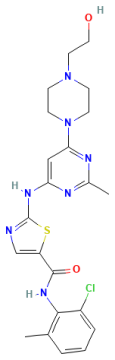
Compound data
Identifiers
- IUPAC name
- N-(2-chloro-6-methylphenyl)-2-[[6-[4-(2-hydroxyethyl)piperazin-1-yl]-2-methylpyrimidin-4-yl]amino]-1,3-thiazole-5-carboxamide
- Synonyms
- BMS-354825, Sprycel
- InChIKey
- ZBNZXTGUTAYRHI-UHFFFAOYSA-N
- SMILES
- CC1=C(C(=CC=C1)Cl)NC(=O)C2=CN=C(S2)NC3=CC(=NC(=N3)C)N4CCN(CC4)CCO
Properties
- Formula
- C22H26ClN7O2S
- Molecular weight
- 488.0 g/mol
- Monoisotopic mass
- 487.1557220 Da
- XLogP3
- 3.6
- Polar surface area
- 135 Ų
- H-bond donors / acceptors
- 3 / 9
- Rotatable bonds
- 7
- Heavy atoms
- 33
- Formal charge
- 0
Computed by PubChem from the structure. About these values
Classification
- Mechanisms studied
- Origin
- Synthetic aminothiazole kinase inhibitor
- First described
- 2004
- Status
- Approved medicine
- Last reviewed
This record summarises chemistry and published research. It gives no doses, protocols or sources, and it is not a recommendation to use this compound.
Overview
Dasatinib is an oral multi-kinase inhibitor developed by Bristol-Myers Squibb. In oncology it blocks the BCR-ABL fusion kinase that drives chronic myeloid leukaemia, including many imatinib-resistant forms. In aging research it is best known as one half of the “D+Q” senolytic combination with the flavonoid quercetin.
Mechanism
Senescent cells resist apoptosis by up-regulating a network of pro-survival pathways. Zhu and colleagues compared the transcriptomes of senescent and non-senescent cells to find these “senescent cell anti-apoptotic pathways” and then screened for drugs that block them. Dasatinib, which inhibits SRC-family and other tyrosine kinases involved in survival signalling, killed senescent human fat-cell progenitors; quercetin was more effective against senescent endothelial cells, and the combination covered both (Zhu et al., 2015).
Research history
Dasatinib was approved in 2006 for chronic myeloid leukaemia. Its repositioning as a senolytic in 2015 was the first demonstration that senescent cells could be targeted with drugs rather than with genetic tools, which had shown in mice that removing senescent cells delays several age-related changes.
Preclinical literature
In mice, intermittent D+Q reduced senescent cell burden, improved physical function after transplantation of senescent cells, and, when started in very old animals, increased remaining lifespan and reduced mortality risk (Xu et al., 2018). Because senolytics only need to act while senescent cells are present, these studies used short courses separated by long gaps.
Human research & status
Two small open-label pilot studies reported the first human results. In 14 people with idiopathic pulmonary fibrosis, three weeks of intermittent D+Q improved some measures of physical function, with no change in lung function (Justice et al., 2019). In nine people with diabetic kidney disease, a three-day course lowered markers of senescent cells in adipose tissue and skin (Hickson et al., 2019). Larger controlled trials are under way. Dasatinib has serious known side effects, including fluid retention, pleural effusion and low blood counts, and is a prescription cancer medicine.
References
- Zhu Y, Tchkonia T, Pirtskhalava T, et al. The Achilles' heel of senescent cells: from transcriptome to senolytic drugs. Aging Cell. 2015;14(4):644-58. DOI PubMed
- Xu M, Pirtskhalava T, Farr JN, et al. Senolytics improve physical function and increase lifespan in old age. Nat Med. 2018;24(8):1246-1256. DOI PubMed
- Justice JN, Nambiar AM, Tchkonia T, et al. Senolytics in idiopathic pulmonary fibrosis: Results from a first-in-human, open-label, pilot study. EBioMedicine. 2019;40:554-563. DOI PubMed
- Hickson LJ, Langhi Prata LGP, Bobart SA, et al. Senolytics decrease senescent cells in humans: Preliminary report from a clinical trial of Dasatinib plus Quercetin in individuals with diabetic kidney disease. EBioMedicine. 2019;47:446-456. DOI PubMed